Thorncrown Chapel has been on my architecture bucket list ever since I first saw photos of it online. There are plenty of beautiful buildings in the world, but something about this one immediately caught my attention. A glass chapel tucked into the Ozark woods, surrounded by trees and stone, sounded like exactly the kind of place I wanted to see for myself. And after finally visiting, I can say that the photos really don’t do it justice.
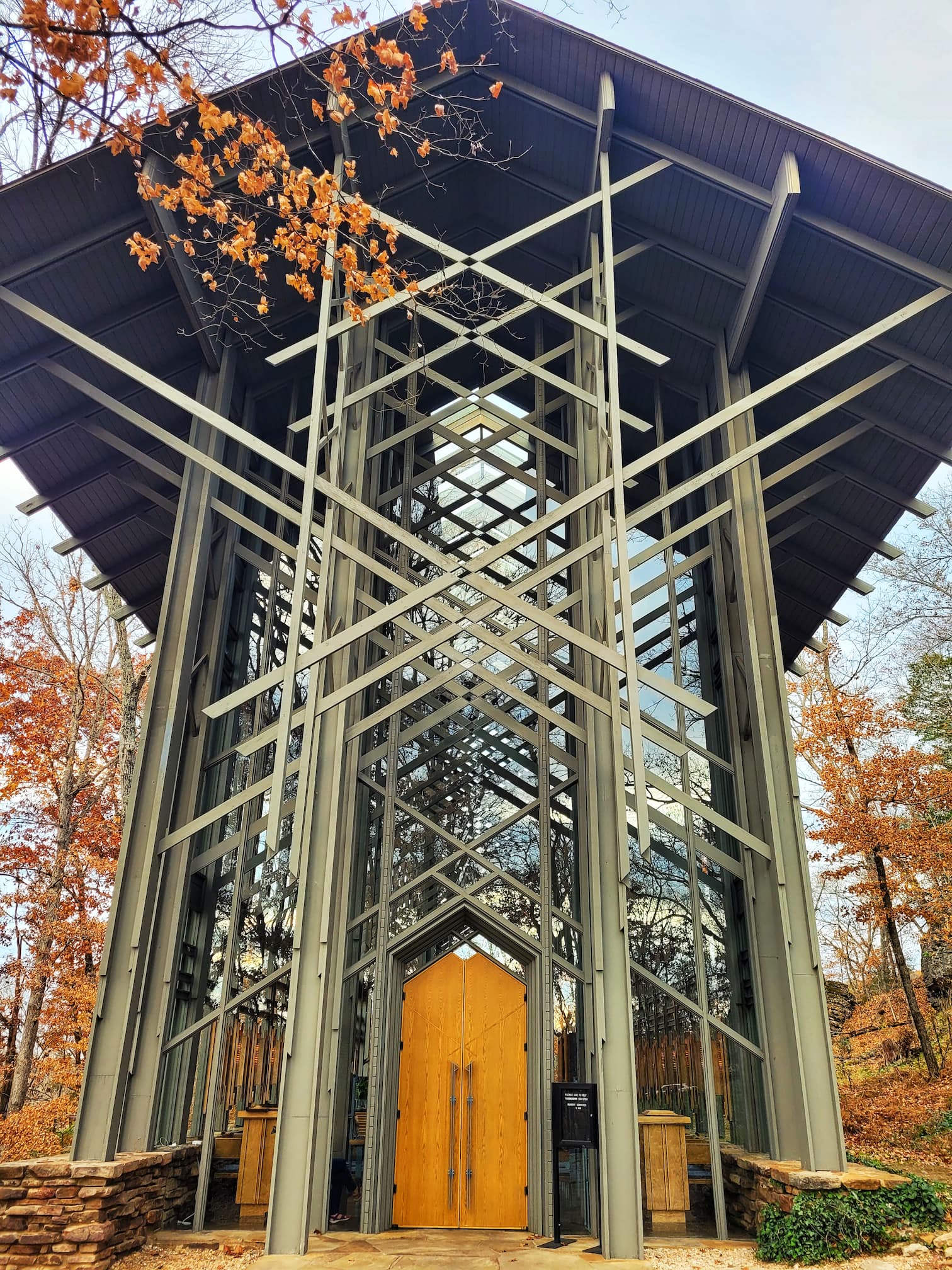
There is something almost strange about Thorncrown Chapel when you first see it. From the outside, with its enormous glass walls and soaring wooden trusses, it can look almost as though there isn’t a building there at all. It feels less like something that was constructed in the woods and more like something that somehow grew there, and that’s exactly what architect E. Fay Jones was trying to accomplish.
About Thorncrown Chapel
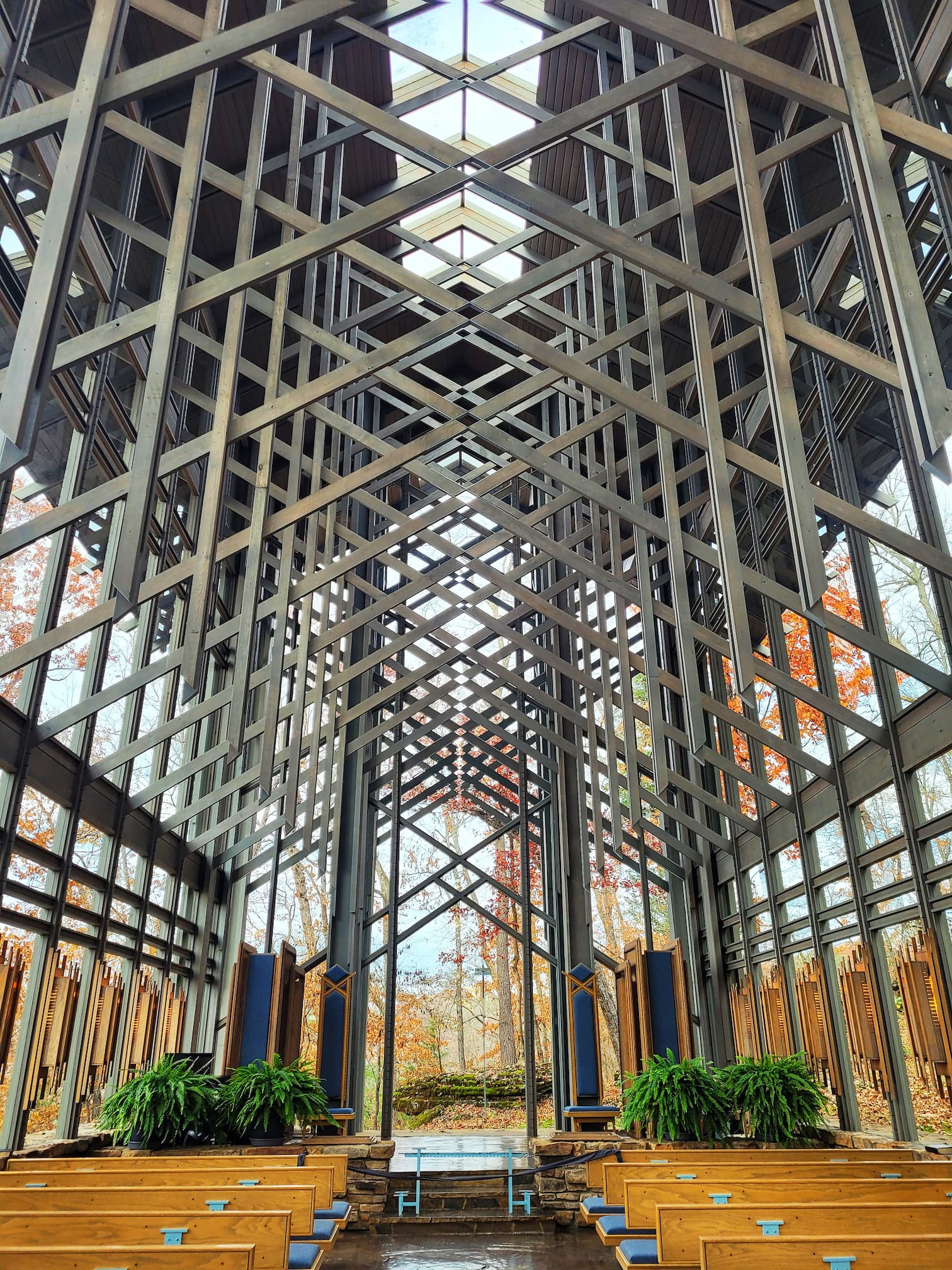
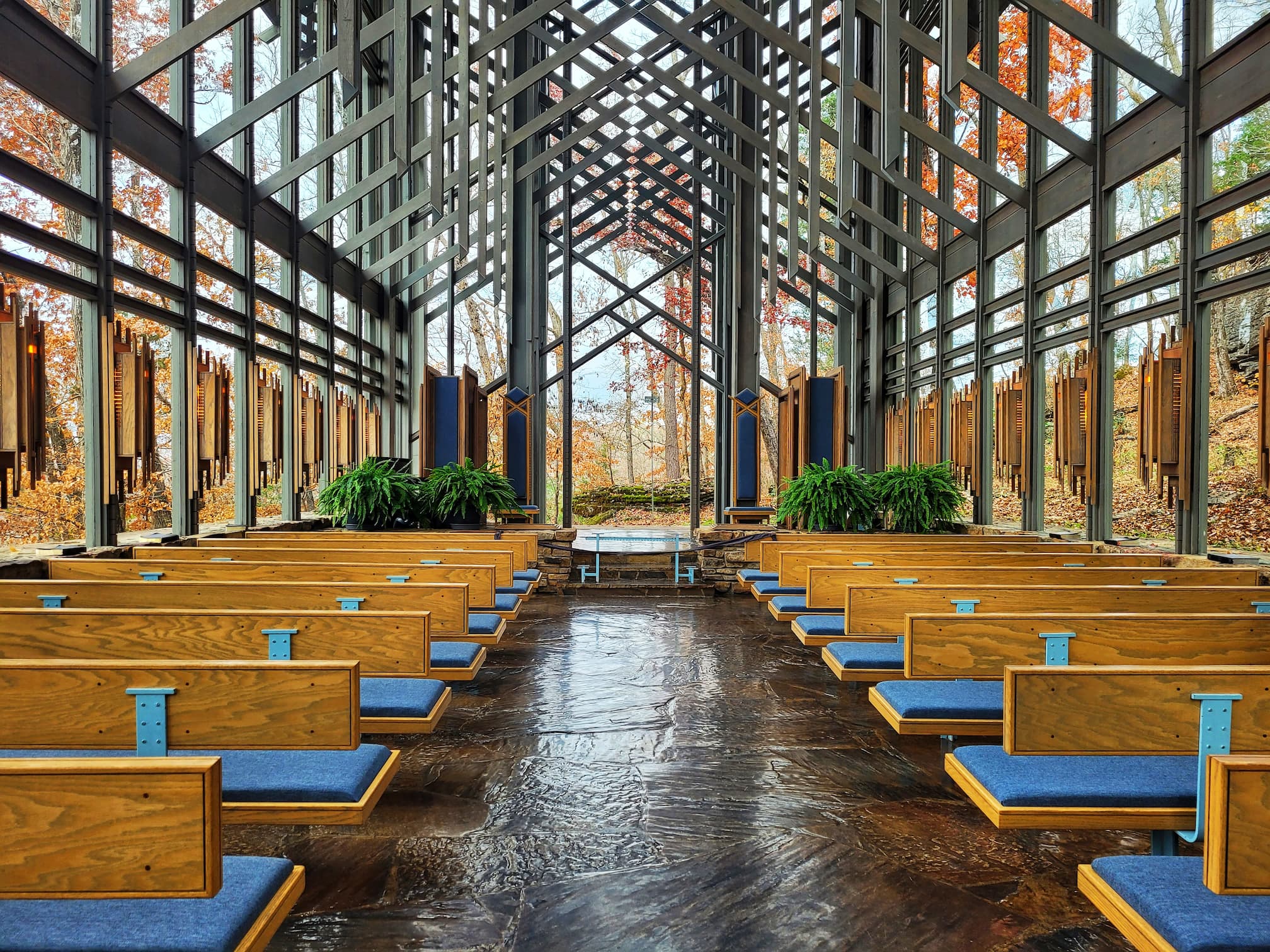
Thorncrown Chapel stands 48 feet tall and contains 425 windows, adding up to more than 6,000 square feet of glass. The chapel is only 24 feet wide but stretches 60 feet long, creating a tall, narrow space that emphasizes the dramatic wooden trusses overhead. The result is a building that feels remarkably open to the forest around it. When you’re standing outside, it’s easy to look through the walls and wonder where the building ends and the woods begin.
Inside, the experience changes constantly as the sun moves across the sky. Light and shadow are essentially part of the architecture. Sunlight filters through the trees and windows, creating patterns across the flagstone floor and wooden structure. The leaves outside move with the wind, constantly changing those patterns. Thorncrown doesn’t look exactly the same from one hour to the next, or from one season to another. Even the surrounding trees become part of the design.
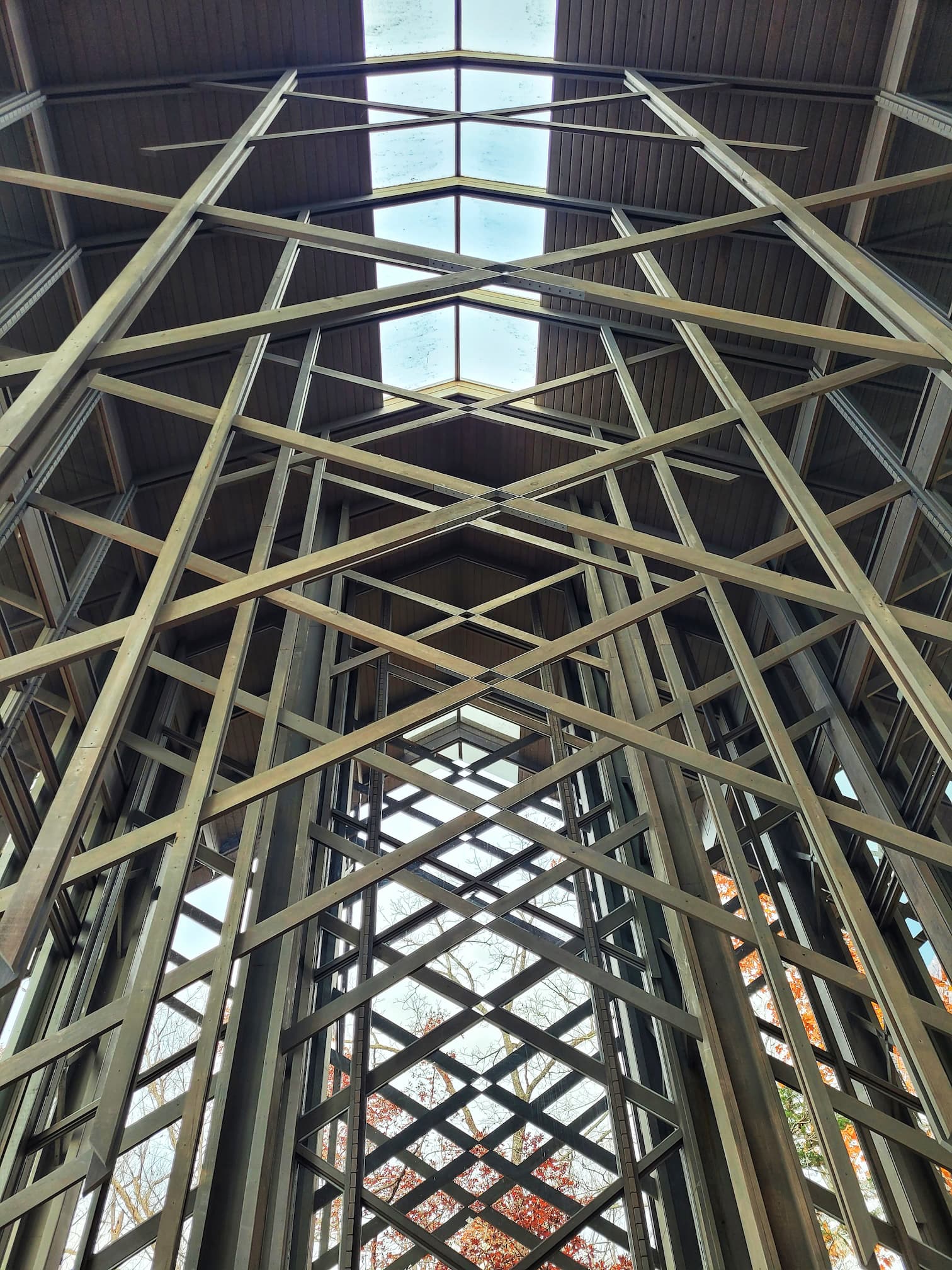
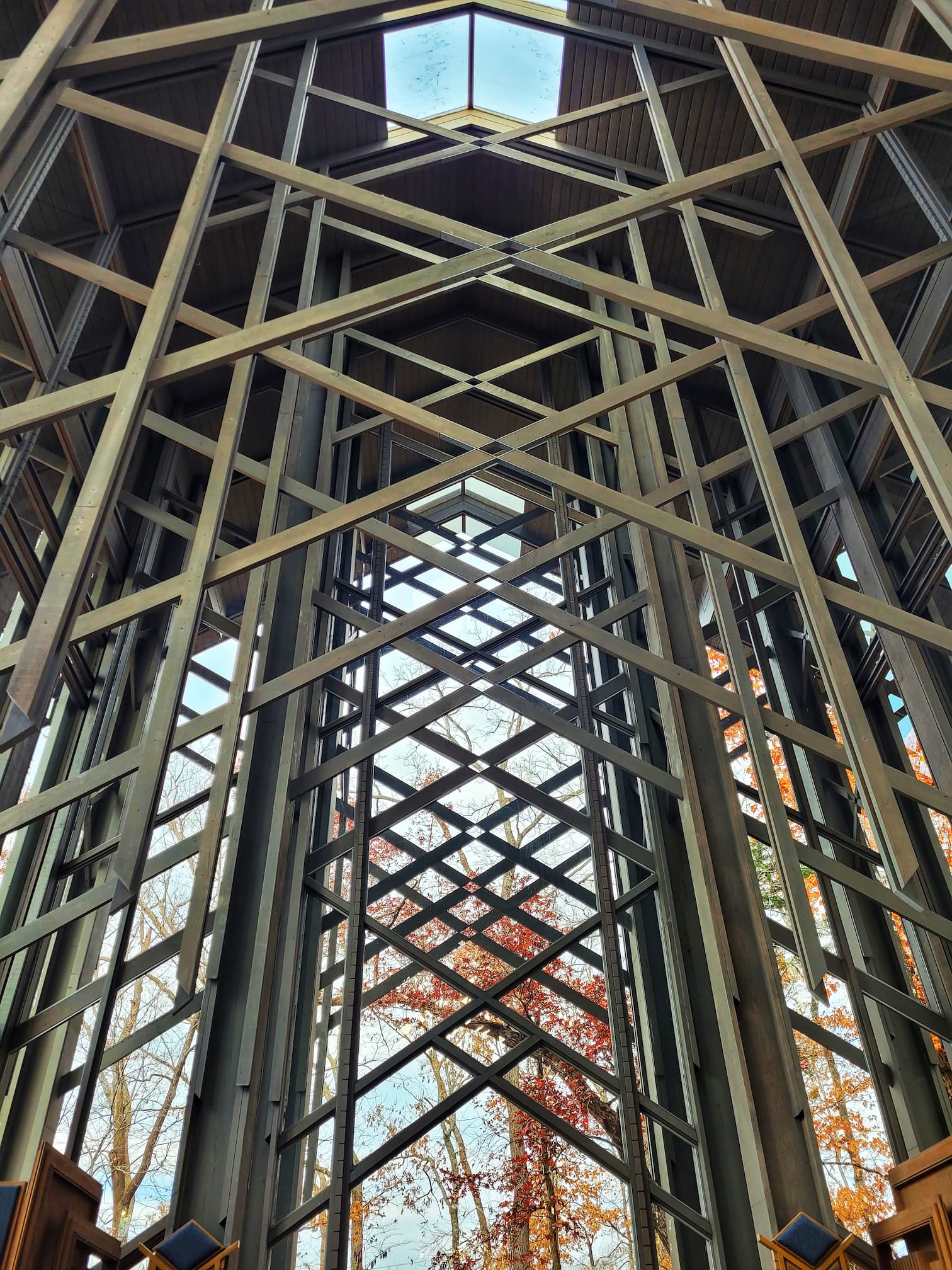
The materials were chosen with that same idea in mind. Jones wanted the chapel to feel as though it belonged in its natural setting, rather than looking like a building that had simply been dropped into the forest. The structure is made primarily from natural materials, with the only steel used in the diamond-shaped portions of the wooden trusses. The floor is made from native flagstone, and the chapel rests on more than 100 tons of natural stone. One of Jones’ rules was that no structural element could be larger than what two men could carry through the woods. That meant the chapel could be built without dramatically disturbing the landscape around it. The large wooden trusses were assembled on the ground and then raised into place.
The repetition of the wooden trusses gives the chapel its almost cathedral-like quality, while the glass keeps it connected to the forest. Jones called his approach “Ozark Gothic,” combining the soaring forms associated with Gothic architecture with the natural materials and landscape of the Ozarks.
The History of Thorncrown Chapel
Thorncrown Chapel began with an idea from a retired schoolteacher named Jim Reed. In 1971, Reed and his wife purchased 26 acres outside Eureka Springs, Arkansas, planning to build a retirement home. But their property had something they hadn’t necessarily expected: people kept stopping to admire the sweeping views of the Ozark hills. Rather than trying to keep those visitors away, Reed invited them in.
Eventually, an idea began to take shape. He imagined building a glass chapel in the woods that could serve as a kind of wayside pilgrimage, a place where visitors could stop, enjoy the setting and spend a little time in quiet contemplation. The next step was finding someone who could turn that idea into reality. That person was Arkansas architect E. Fay Jones.
E. Fay Jones
E. Fay Jones was born in Pine Bluff, Arkansas, in 1921. He studied architecture at several universities before eventually becoming a student and later fellow of Frank Lloyd Wright’s Taliesin Fellowship. He went on to become an influential architect and educator in Arkansas, and his work is often discussed in connection with Wright’s philosophy of organic architecture. Jones had actually been interested in architecture from an early age. As a child, he built treehouses and other structures, but it was seeing a short film about Frank Lloyd Wright’s Johnson Wax headquarters that helped convince him that architecture was something he wanted to pursue seriously.
One of Jones’ major inspirations was Sainte-Chapelle in Paris, the famous Gothic chapel known for its enormous stained-glass windows and extraordinary use of light. That influence is particularly fitting when you stand inside Thorncrown. Jones wasn’t copying the Parisian chapel, but he was taking the idea of a sacred space transformed by light and reinterpreting it for the Ozarks. The name Thorncrown also came from Sainte-Chapelle’s, which houses many religious relics, including a crown of thorns… hence, Thorncrown.
Building the Chapel
Construction began in March 1979. But, halfway through construction, the project ran out of money. Construction stopped, and Reed began to believe the chapel might never be completed. But a woman in Illinois ultimately provided Reed with a loan at a fraction of the prevailing interest rate, allowing construction to resume.
The story of the chapel’s construction is almost as interesting as the building itself. The trusses were assembled on the ground before being raised into position, and installing all 425 panes of glass was a painstaking process. Even the smaller details were carefully considered, from the chapel doors to the pews and light fixtures.
The chapel finally opened to the public in July 1980. And it was immediately clear that people were going to be interested in this unusual little building in the woods.
An Architectural Masterpiece
Thorncrown Chapel quickly attracted attention from both visitors and the architectural world. In 1981, just a year after it opened, the chapel received the American Institute of Architects’ National Honor Award. It later became one of the buildings recognized among the AIA’s top designs of the 20th century, and in 2006 it received the AIA’s 25 Year Award.
It was also added to the National Register of Historic Places in 2000. That might not sound particularly unusual until you realize just how young Thorncrown was at the time. The National Register generally requires properties to be at least 50 years old to qualify. Buildings younger than that can still be listed, but they have to demonstrate exceptional importance. Thorncrown was only about 20 years old when it was listed, and the National Park Service specifically recognized the chapel as an exceptional example of modern architecture and organic design.
And perhaps the best evidence of just how beloved Thorncrown became is the number of people who have come to see it. The chapel says more than nine million people have visited since it opened in 1980.
Our Visit to Thorncrown Chapel
We pulled into the winding drive at Thorncrown Chapel not exactly knowing what to expect. I’d seen plenty of photos over the years, so I knew what the chapel looked like, but there is a big difference between seeing a picture online and actually walking through the woods toward it. As soon as we got our first glimpse of the building, I wanted to stop and just look at it for a minute. It really is one of those places that looks impressive in photos but somehow even better in person.
What struck me most was how well it fits into the landscape. You can obviously tell that it’s a building, but it doesn’t feel like someone came into the woods, cleared a big space and dropped a giant glass structure in the middle of it. The glass almost disappears against the trees, and the wooden framework feels like it belongs there. I kept thinking about Jones’ idea that the chapel should feel like it grew out of the Ozarks, because standing there, I could actually see what he meant.
Once we stepped inside, we spent a while just looking around. The wooden trusses are so much more impressive when you’re standing underneath them, and the sheer amount of glass means that you’re surrounded by the forest from almost every angle. Instead of looking at a stained-glass window or some other carefully constructed view, you’re looking directly at the trees outside. The light was constantly changing as the sun came through the branches, and the shadows moved across the stone floor whenever the trees moved in the breeze.
Thorncrown Chapel absolutely lived up to the spot it had held on my architecture bucket list for years. I loved being able to see all of the things I’d read about, the unusual trusses, the way the chapel is tucked into the landscape, the huge expanses of glass, but what I liked most was realizing that those things aren’t separate from the experience of being there. The building was designed specifically so that the forest, the sunlight and the changing shadows would all become part of it, and that is something you really can’t appreciate from a photograph.
We also stopped in the little gift area before leaving, where they had postcards and a few other souvenirs. It’s a relatively quick visit if you’re just coming to see the chapel, but I would definitely give yourself enough time to walk around and spend a little while inside. Thorncrown is the kind of place where rushing through, taking a few photos and leaving would mean missing a lot of what makes it special.
After visiting, I completely understood why this little chapel in the Ozarks has attracted millions of people over the years. It’s an incredible piece of architecture, but it’s also a really good example of what can happen when a building is designed around its surroundings instead of trying to overpower them. Jones didn’t just build a glass chapel in the woods; he found a way to make the woods part of the chapel, and that’s what makes Thorncrown so memorable.
E. fay Jones died in 2004 at age 83, but over 9 million visitors have enjoyed his work at Thorncrown.
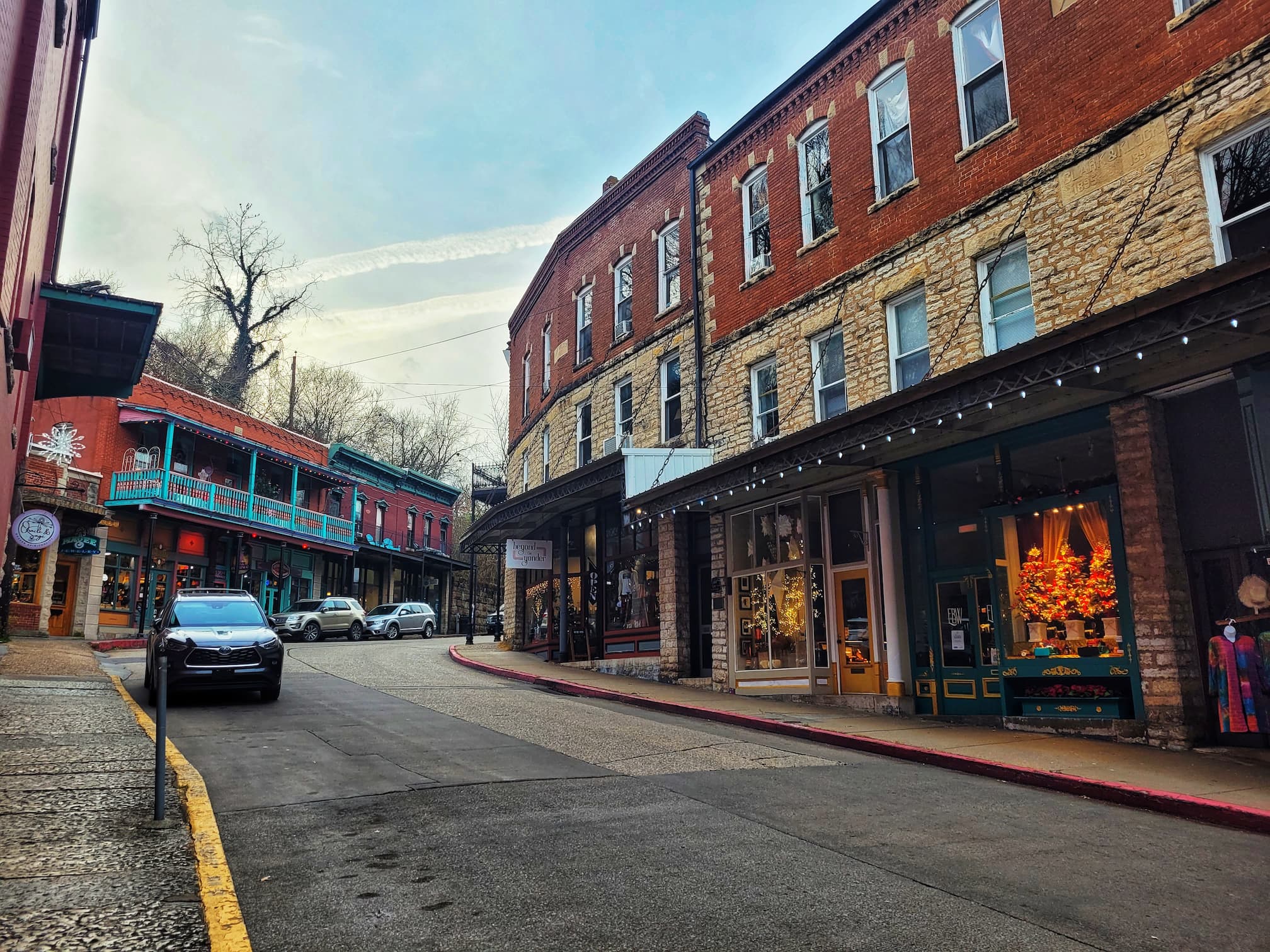
You can read the rest of what we did on this visit to Eureka Springs in this post: Exploring Eureka Springs in the Off Season: What We Did
How to Visit Thorncrown Chapel
The chapel, which seats 100 people, can be rented for weddings and is open to visitors most days between March and December. They also host nondenominational Christian Sunday services in the worship center on the property.
- Hours: March-December 9am-5pm, occasionally closes early for special events in afternoon.
- Sunday services: 9am and 11am April-October. November-third week of December just 11am service.
Tour and church groups get brief presentation on chapel and its history.