I visited the L.R. Ingersoll Wonders of Physics Museum with two of my good friends, and we spent the entire day happily geeking out over science. After working in higher education for most of my career, I’ve never quite lost my love for wandering college campuses. They’re such hidden treasure troves, not just for students, but for anyone curious enough to explore. So many colleges and universities quietly host free museums and collections that are open to the public and often completely overlooked. On this visit to the University of Wisconsin–Madison, we explored one of the country’s earliest hands-on physics museums, stumbled into the annual Physics Fair with open research labs and live demonstrations, and even tracked down a descendant of Isaac Newton’s legendary apple tree. In this post, I’ll walk you through how to visit, what you’ll see inside the museum, highlights from the Physics Fair lab tours, and why this under-the-radar stop deserves a spot on your Madison itinerary.
All About the L.R. Ingersoll Wonders of Physics Museum
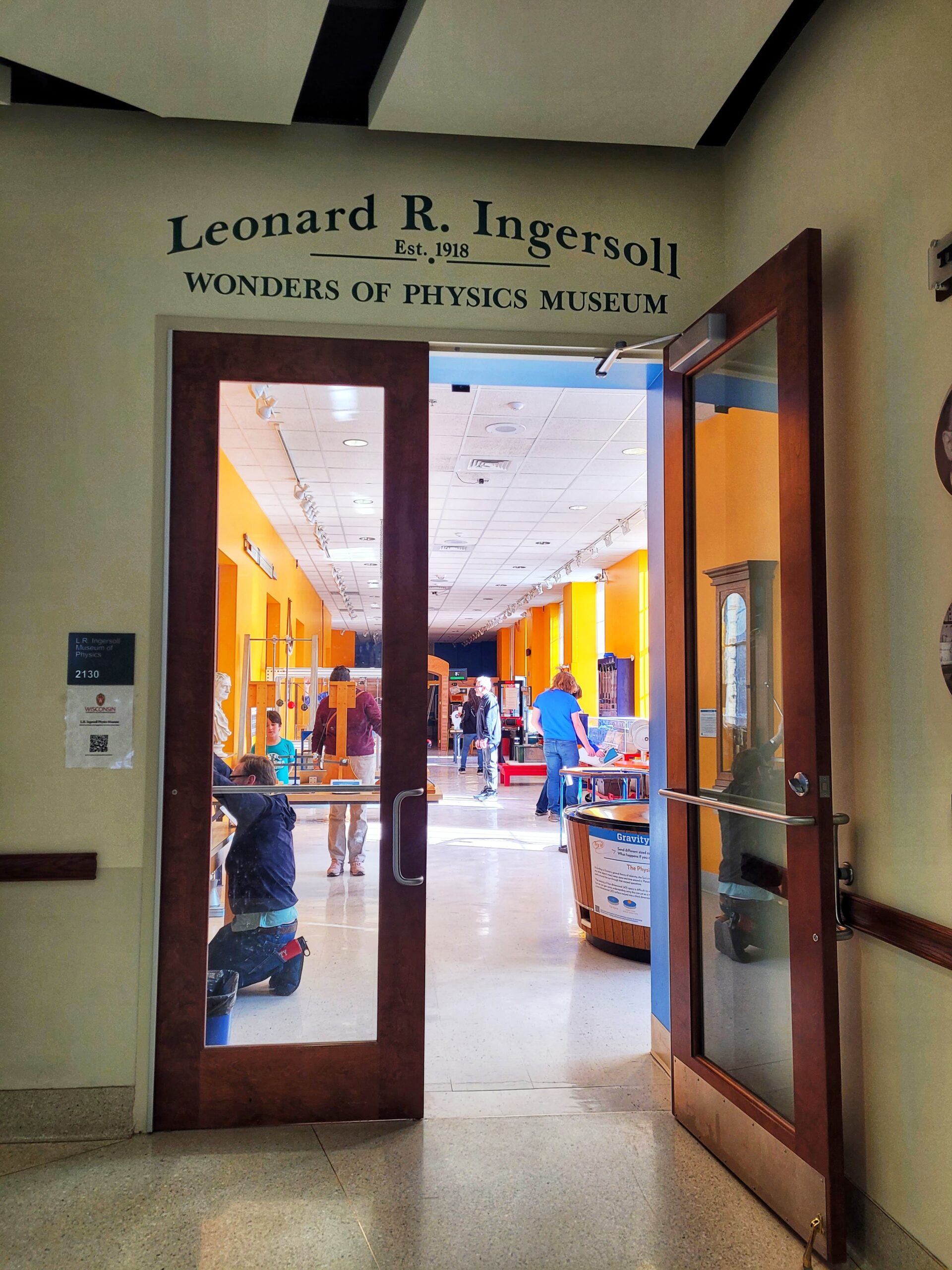
Tucked away on the second floor of Chamberlin Hall, the L.R. Ingersoll Wonders of Physics Museum feels like one of those places you’d only know about if a professor whispered it to you in a hallway. But it’s open to the public, and you absolutely should go.
How to Visit
Website: https://www.physics.wisc.edu/ingersollmuseum/
Hours: Weekdays 8:00am–4:30pm. Select Saturdays 10:00am–1:00pm (check their calendar online)
Cost: Free (runs on donations)
Reservations: Not required unless you’re visiting with a group, then you’ll want to schedule a tour in advance.
Location: Second floor of Chamberlin Hall, 11500 University Ave, on the UW–Madison campus
Parking: There’s no designated museum parking. Lot 20 is the closest to Chamberlin Hall, but always check the university’s visitor parking website for current closures before you go.
About the Museum
The museum was the brainchild of Professor Snow and Professor Ingersoll in 1917 and was fully established in 1918, making it one of the first museums of its kind focused specifically on physics. After Professor Ingersoll passed away in 1958, it was renamed in his honor.
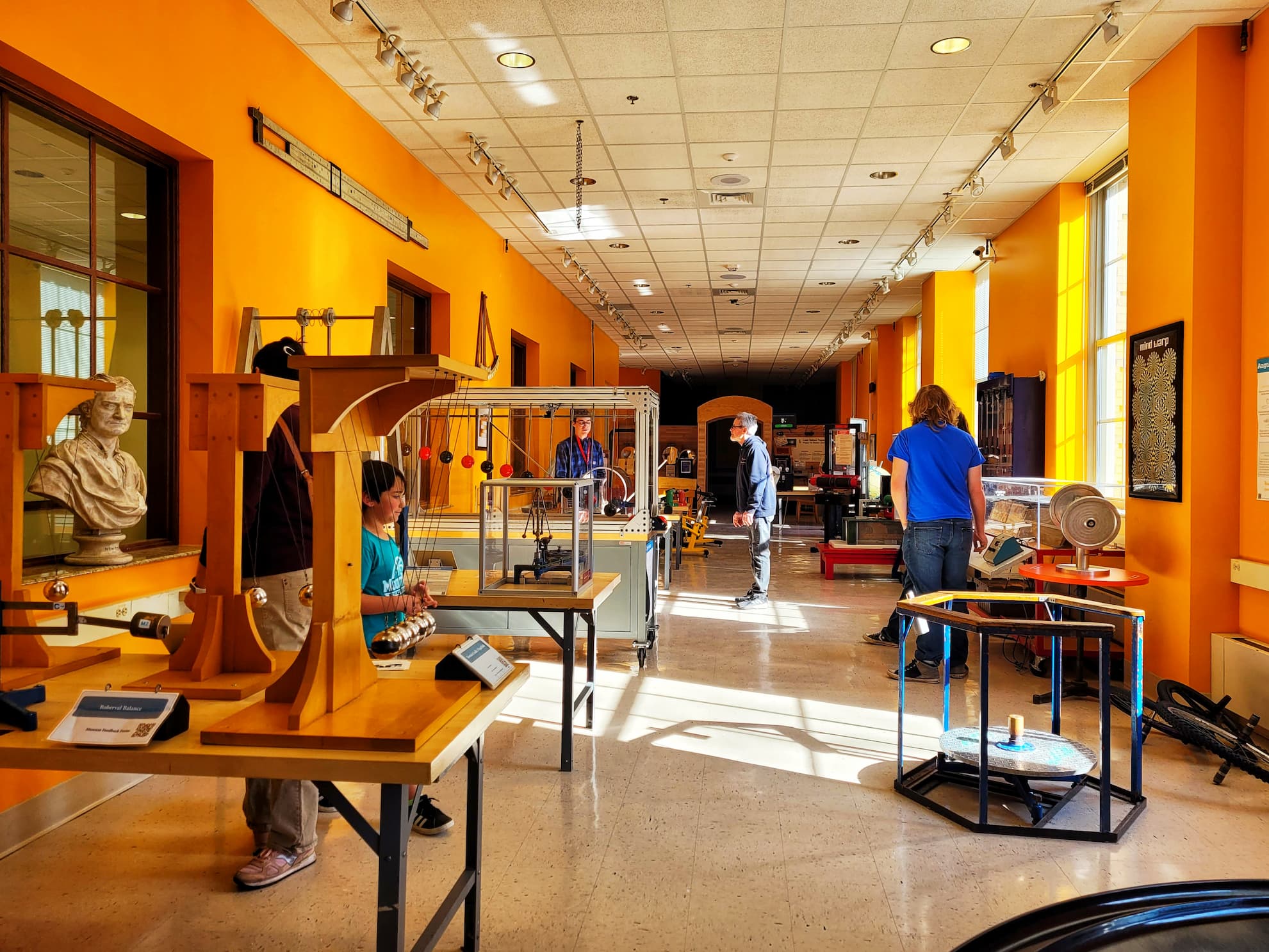
Many of the exhibits were designed by faculty and staff and built by university shops, employees, and students. It feels very “by scientists, for curious people.” The museum itself is about 1,500 square feet, not huge, but packed with over 65 exhibits (some rotate in and out).
And this is not a “look but don’t touch” situation. Just about everything is hands-on, which makes this an extra fun museum!
The exhibits cover everything from basic mechanics to modern physics concepts. You’ll see demonstrations of motion, light, electricity, magnetism, and more, all designed to make abstract ideas feel tangible.
Our Experience at the Ingersoll Wonders of Physics Museum
We all really loved visiting this museum. The hands-on exhibits are incredibly fun, and I thought it was so cool that many of them have plaques saying they are originally 1918 exhibits. Just imagine how many people have learned from these same demonstrations!
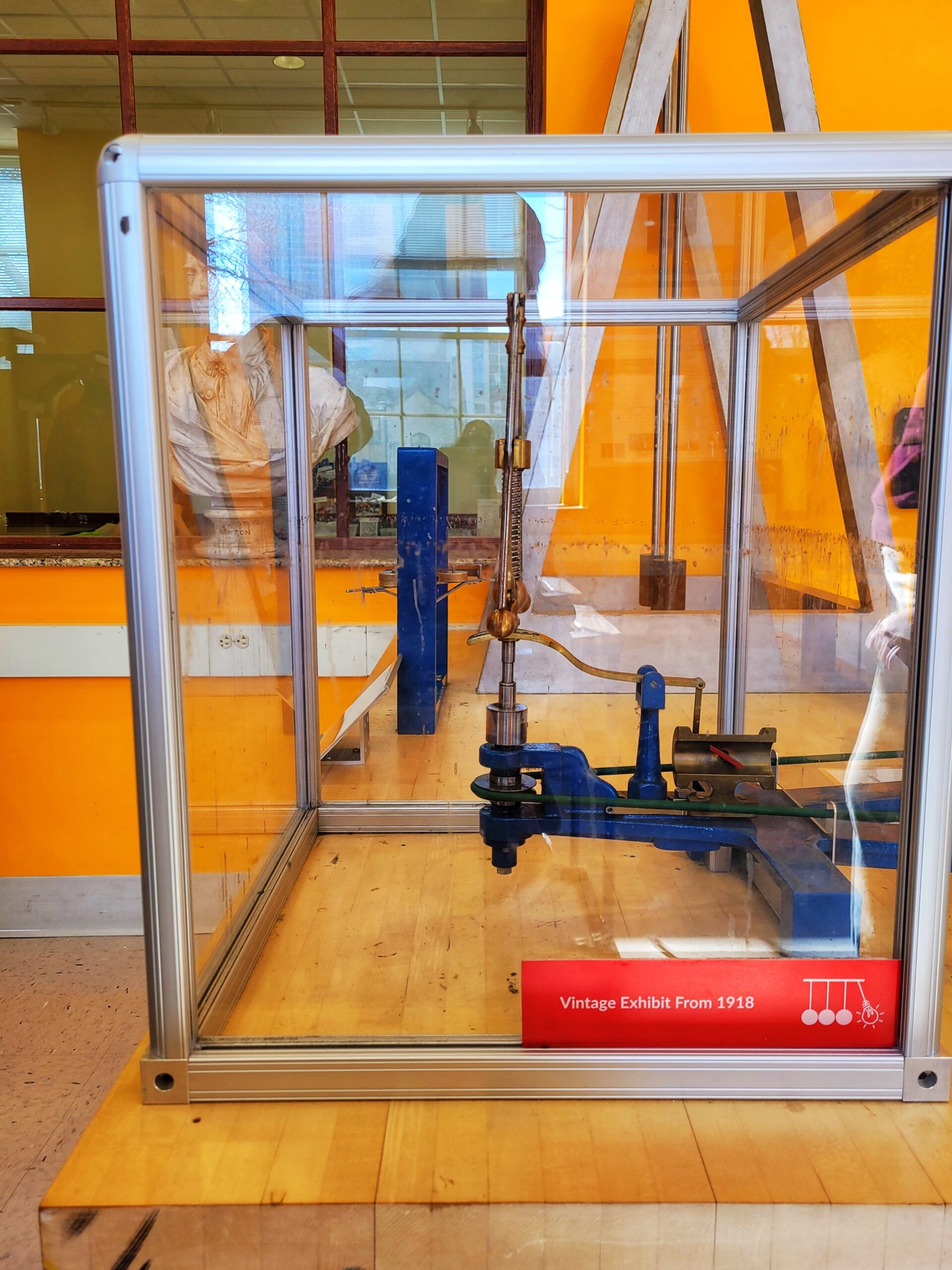
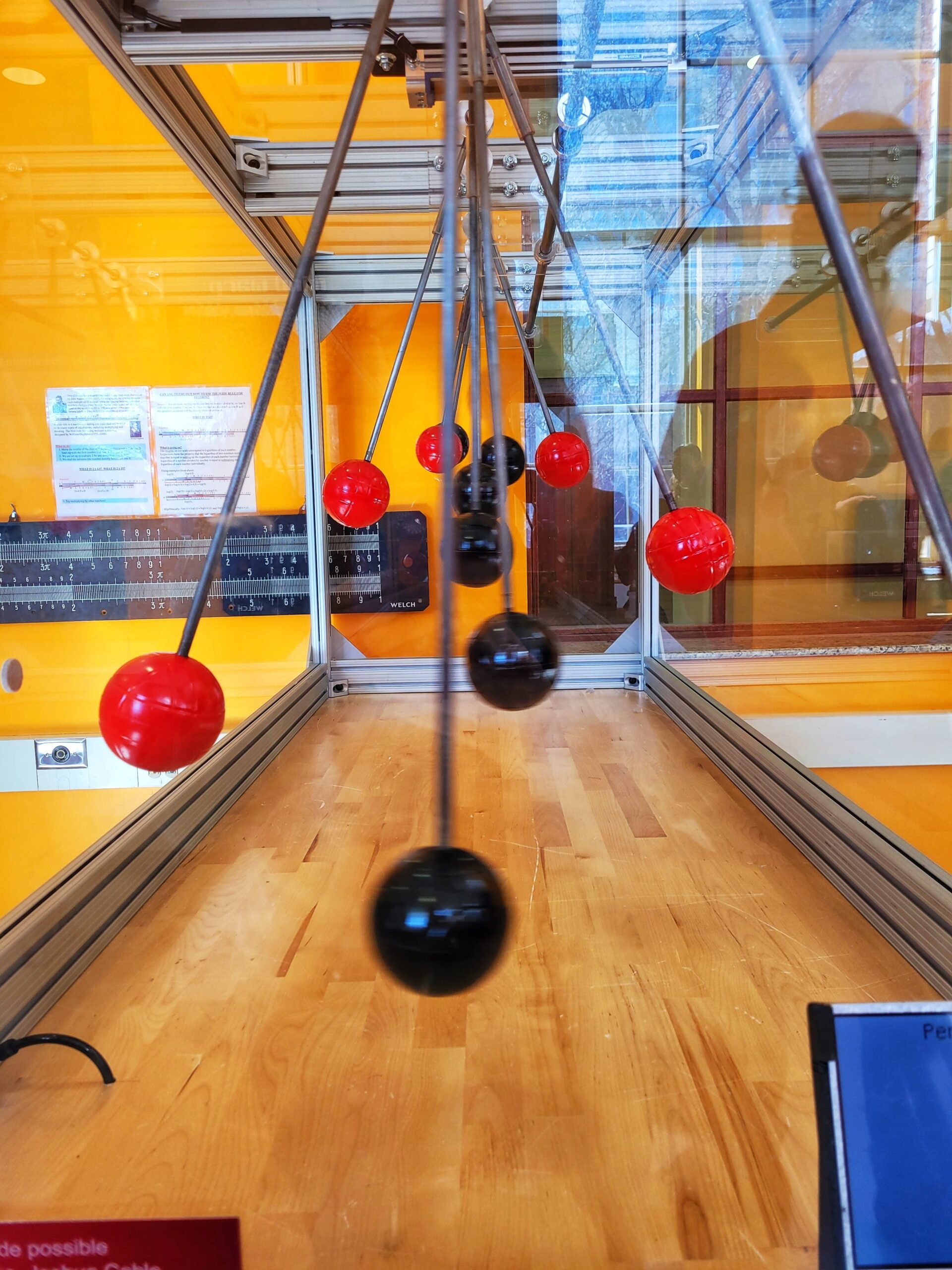
On the left above you can see one of the original 1918 exhibits, which are marked with these little plaques. On the right is a demonstration of pendulum waves.
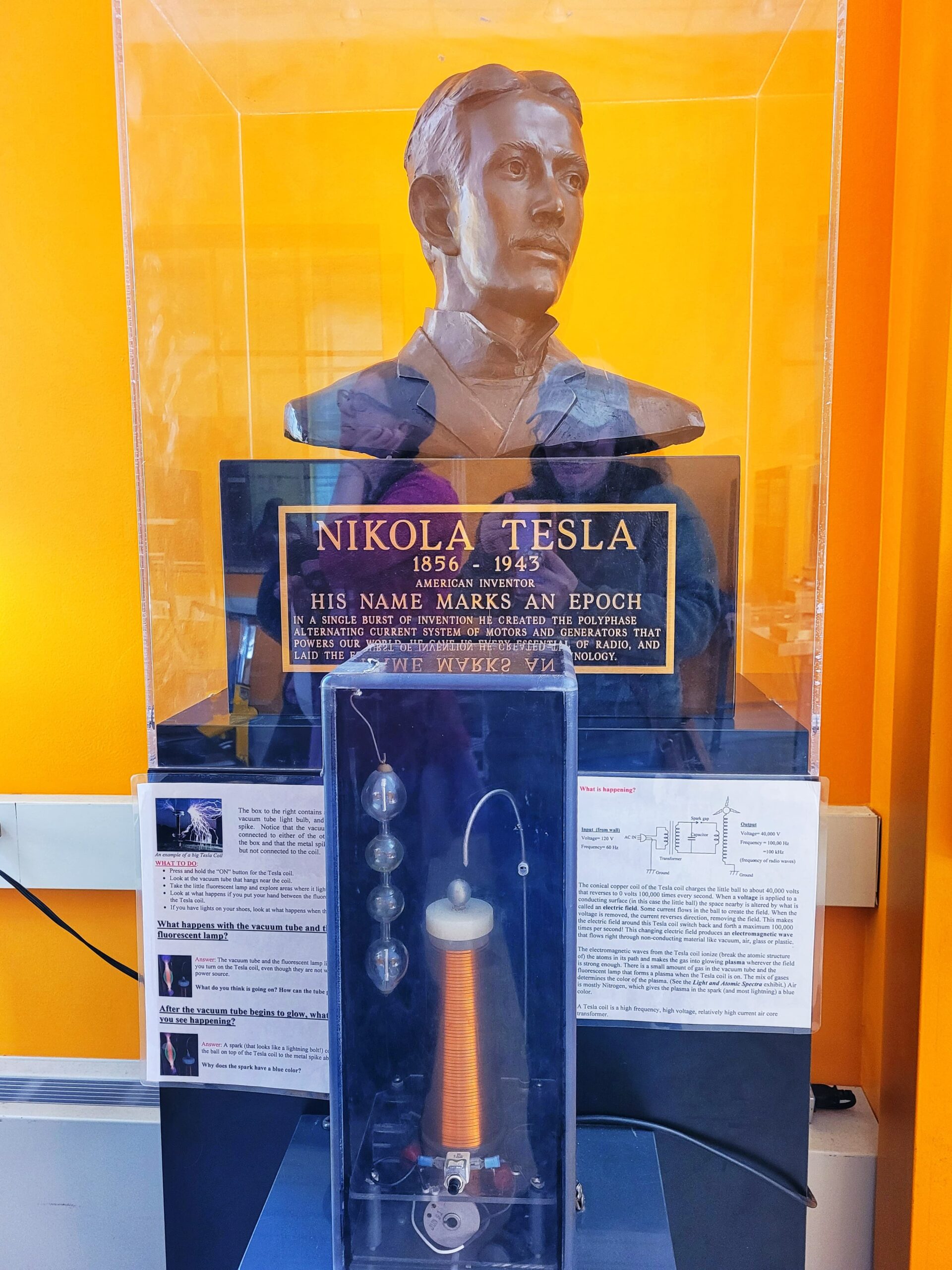
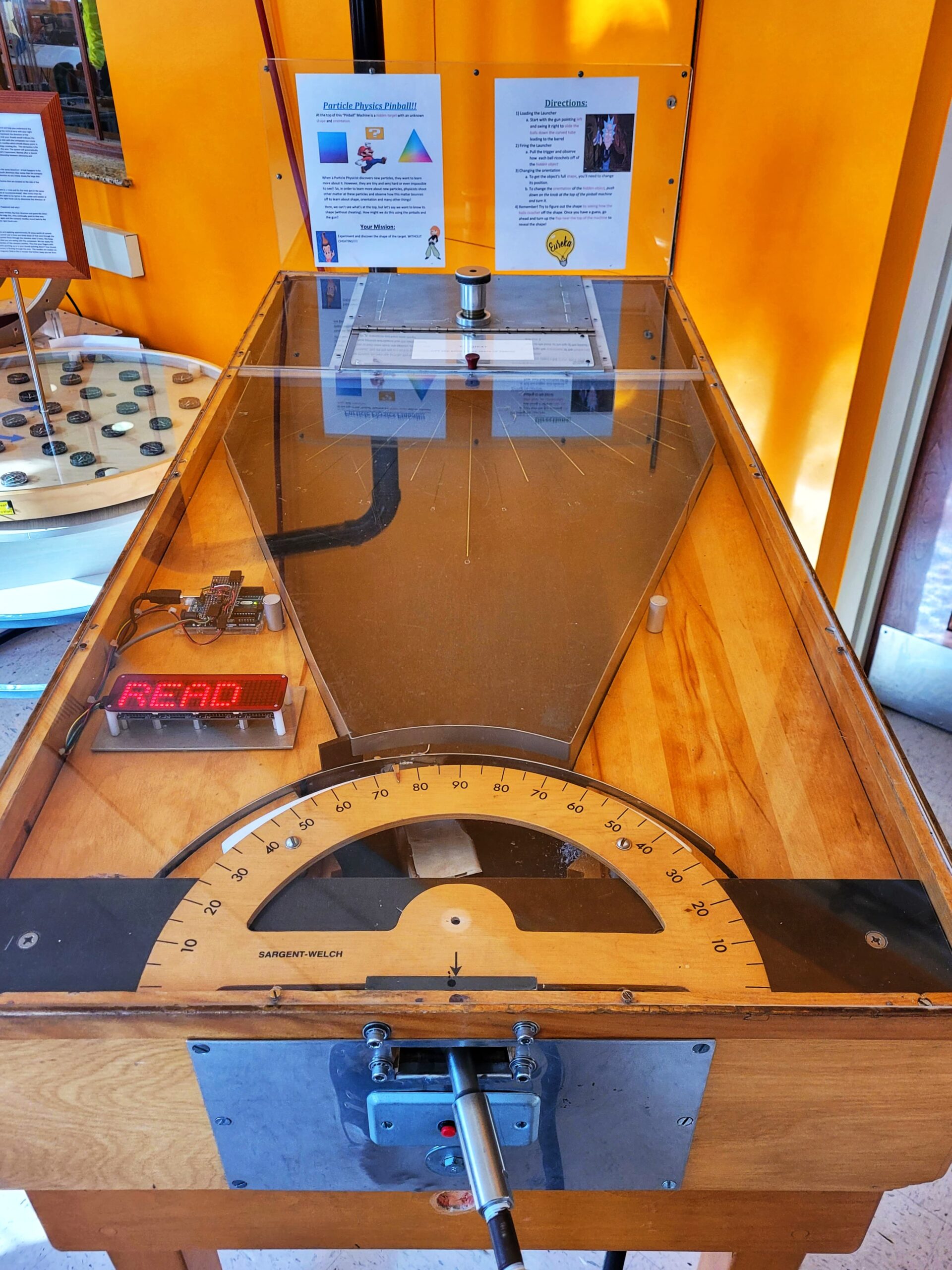
Below on the left, is a working Tesla coil and bust of Nikola Tesla (check out our visit to the Nikola Tesla Museum in Zagreb, Croatia here: Croatia Trip Days 12 & 13: Tamburica Festival & Nikola Tesla Technical Museum). On the right is particle physics pinball!
Visiting The UW-Madison Physics Fair
By complete luck (or very good accidental timing), the day we visited the L.R. Ingersoll Wonders of Physics Museum was also the annual Physics Fair.
The fair is part of the university’s larger Wonders of Physics programming, including the Annual Wonders of Physics Shows, which were completely sold out, but the fair itself was open to walk-ins. I had actually first seen mention of it on a Wisconsin educators’ website. It wasn’t listed on the museum’s public calendar, so when we showed up that morning I genuinely wasn’t sure if it was happening or if I had misread something. Thankfully, the crowds gathering in Chamberlin Hall confirmed that yes, we had stumbled into something special.
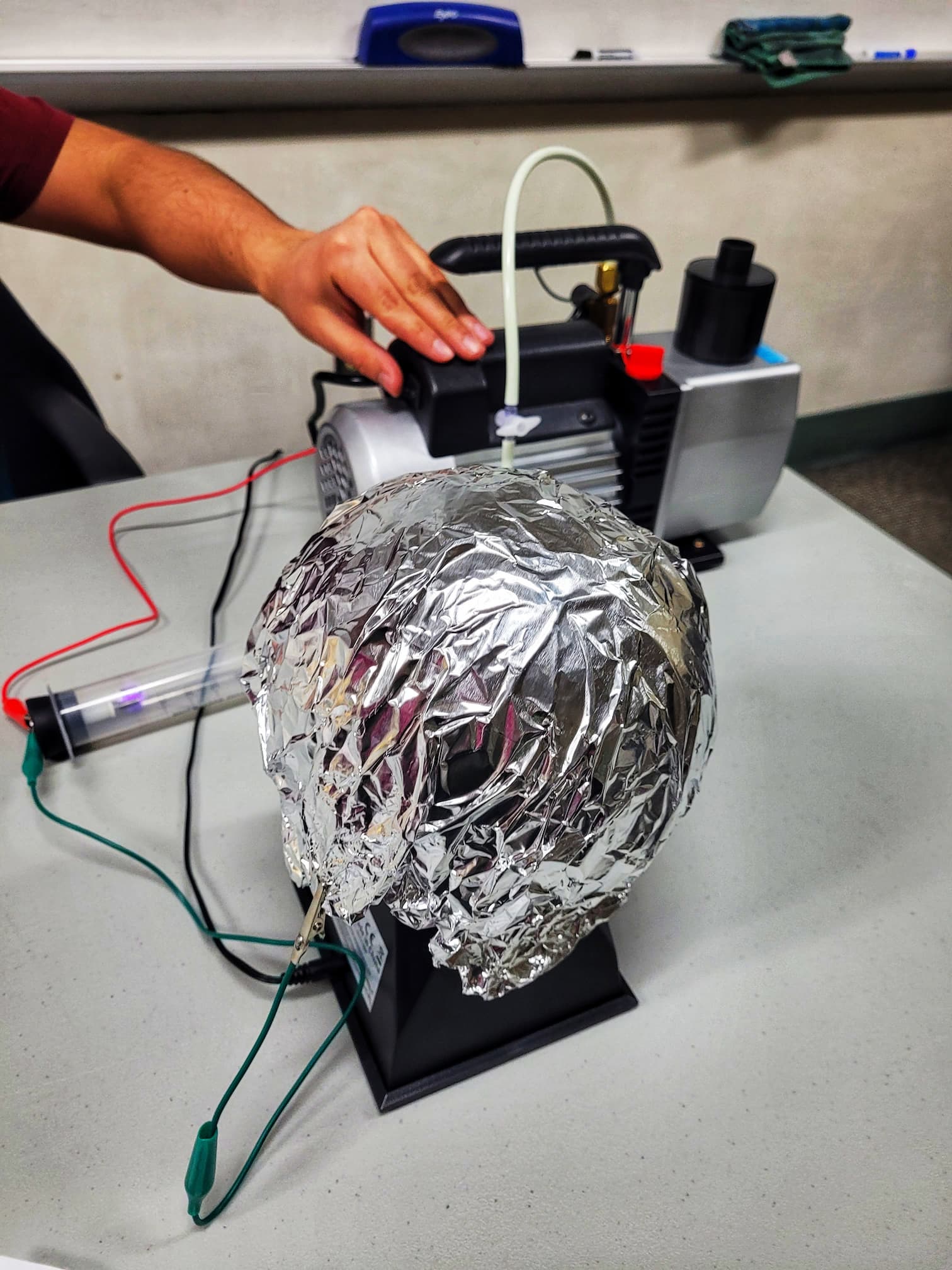
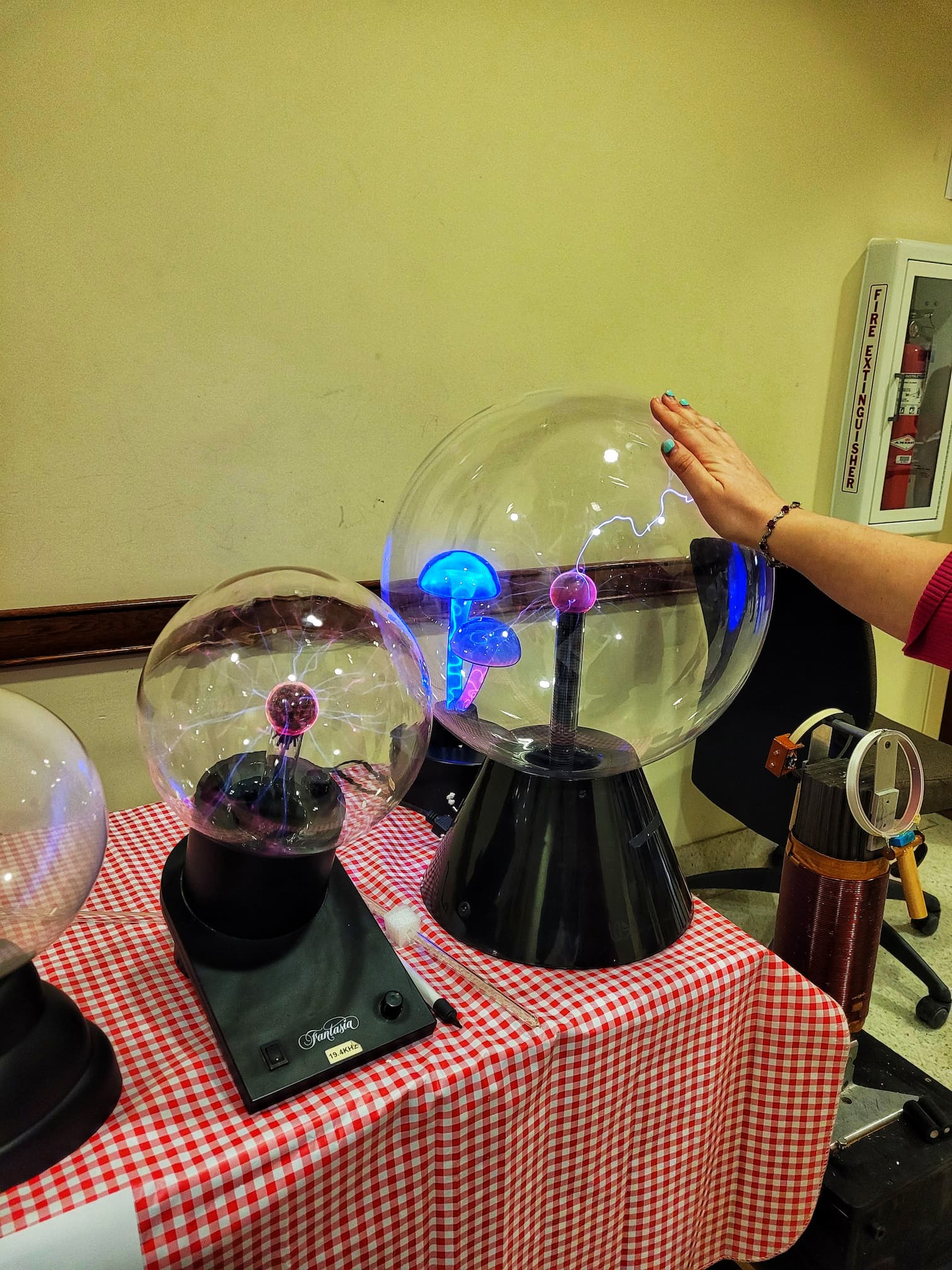
The Physics Fair transforms the physics building into an open house. University clubs and research groups line the hallways with tables full of demonstrations and hands-on activities, while multiple research labs throughout the building open their doors for guided tours.
One of the most fun details was the “Physics Fair Passport,” which we picked up at the start. Each lab visit earned a sticker, turning the day into a kind of academic scavenger hunt and encouraging visitors to explore spaces they might not otherwise think to enter.
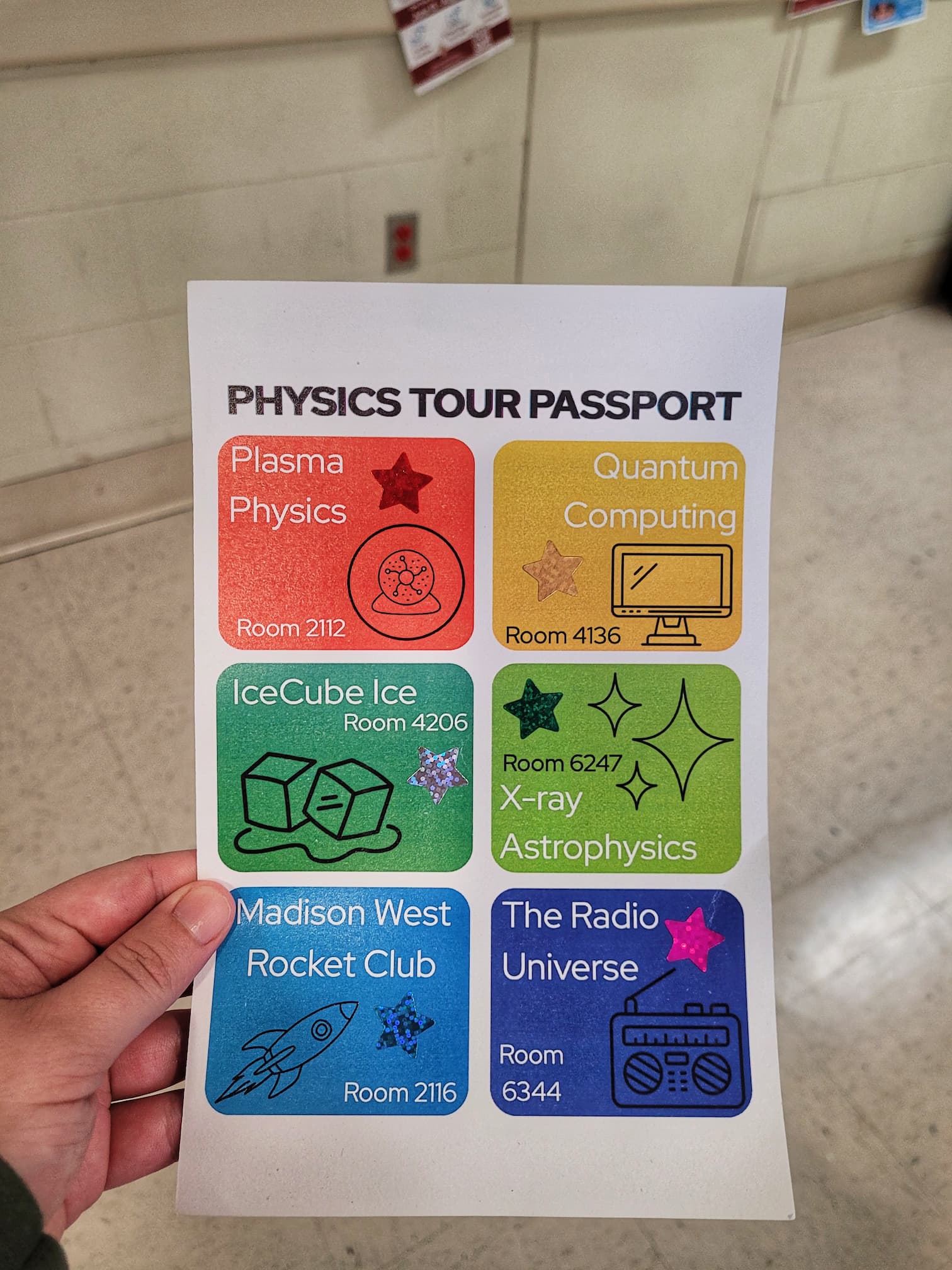
Below are some of the labs and research groups we toured, and why each one ended up being far more fascinating than I expected.
Quantum Computing Lab
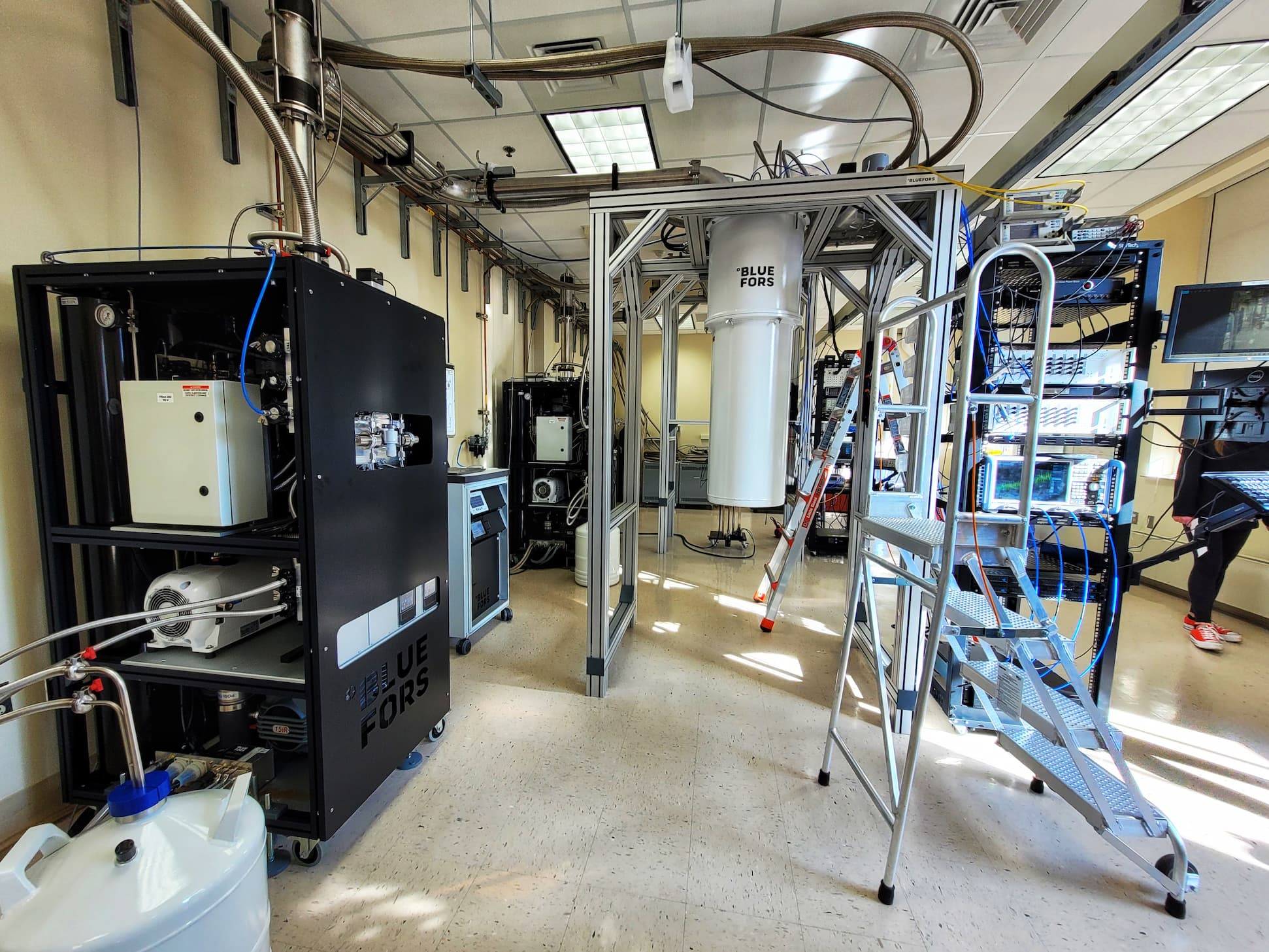
One of our first stops introduced us to a research group working on superconducting circuits for quantum computing. A grad student gave us an overview of the project and explained how they hope to use superconductors for solving problems that ordinary computers could never handle.
Vocab of the Day
Superconductor: A material that conducts electricity with zero resistance and expels magnetic fields when cooled below a certain temperature.
Quantum computing: A form of computing that uses the principles of quantum mechanics to solve problems too complex for classical computers. Instead of bits that are either 0 or 1, quantum computers use qubits, which can be 0, 1, or both at the same time, allowing them to explore many possible solutions simultaneously.
IceCube Neutrino Observatory
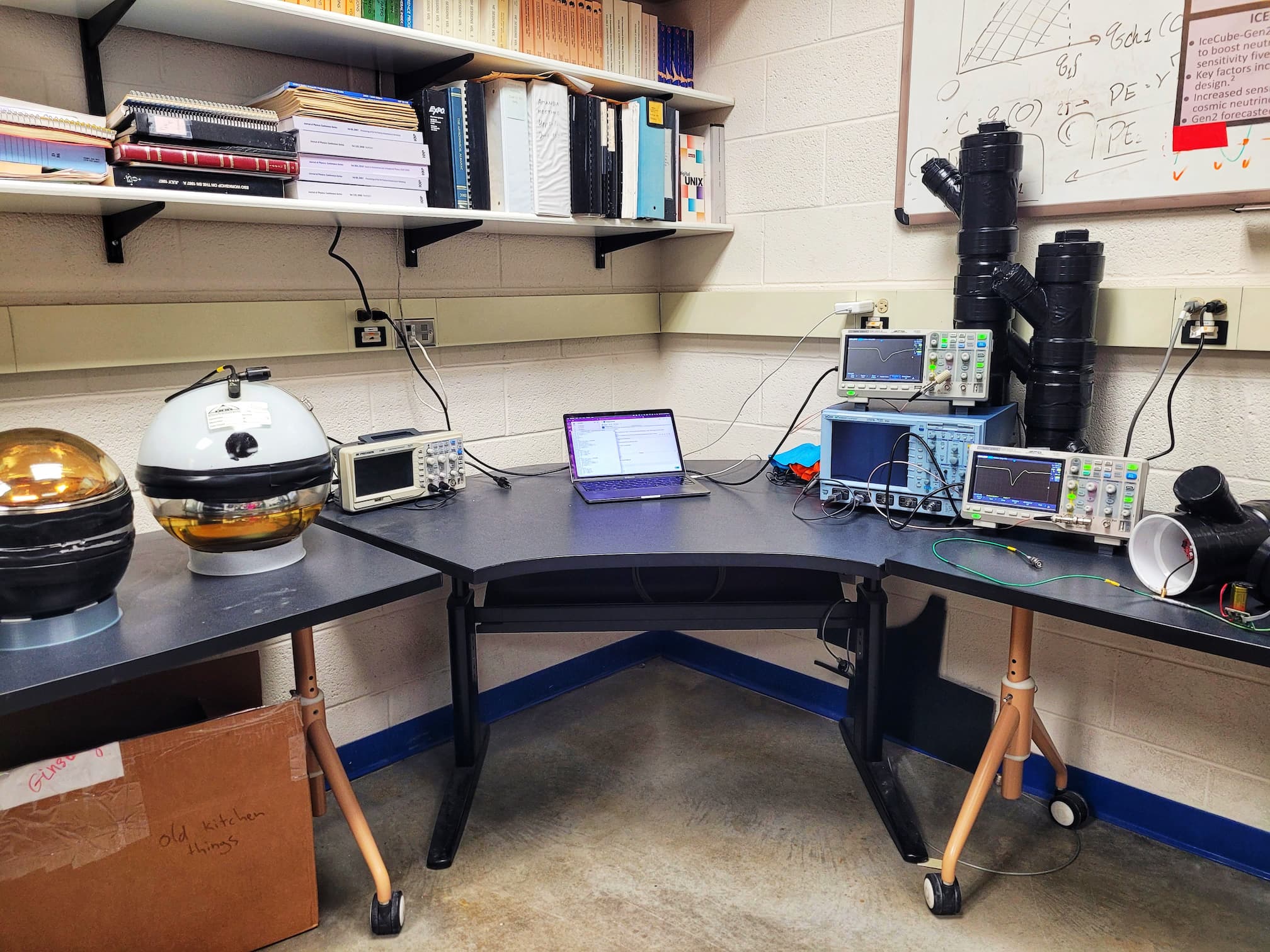
One of the most impressive projects we learned about was the IceCube Neutrino Observatory, for which UW–Madison serves as the lead institution. IceCube is located at the South Pole in Antarctica and consists of thousands of sensors embedded deep beneath the ice. These sensors detect neutrinos- tiny subatomic particles that pass through nearly everything in the universe.
At a table in the hallway, we watched a demonstration showing how researchers drill through Antarctic ice using high-pressure hot water. Later, we visited one of the project offices where we saw examples of the spherical sensors used in the ice and a demonstration of how neutrinos are detected as they pass through water.
The idea that data from sensors buried in Antarctic ice is being analyzed right here in Madison is the kind of global-meets-local science connection I love.
Vocab of the Day
Neutrino: A nearly massless, electrically neutral subatomic particle. They are among the most abundant particles in the universe but are incredibly difficult to detect.
X-Ray Astrophysics Lab
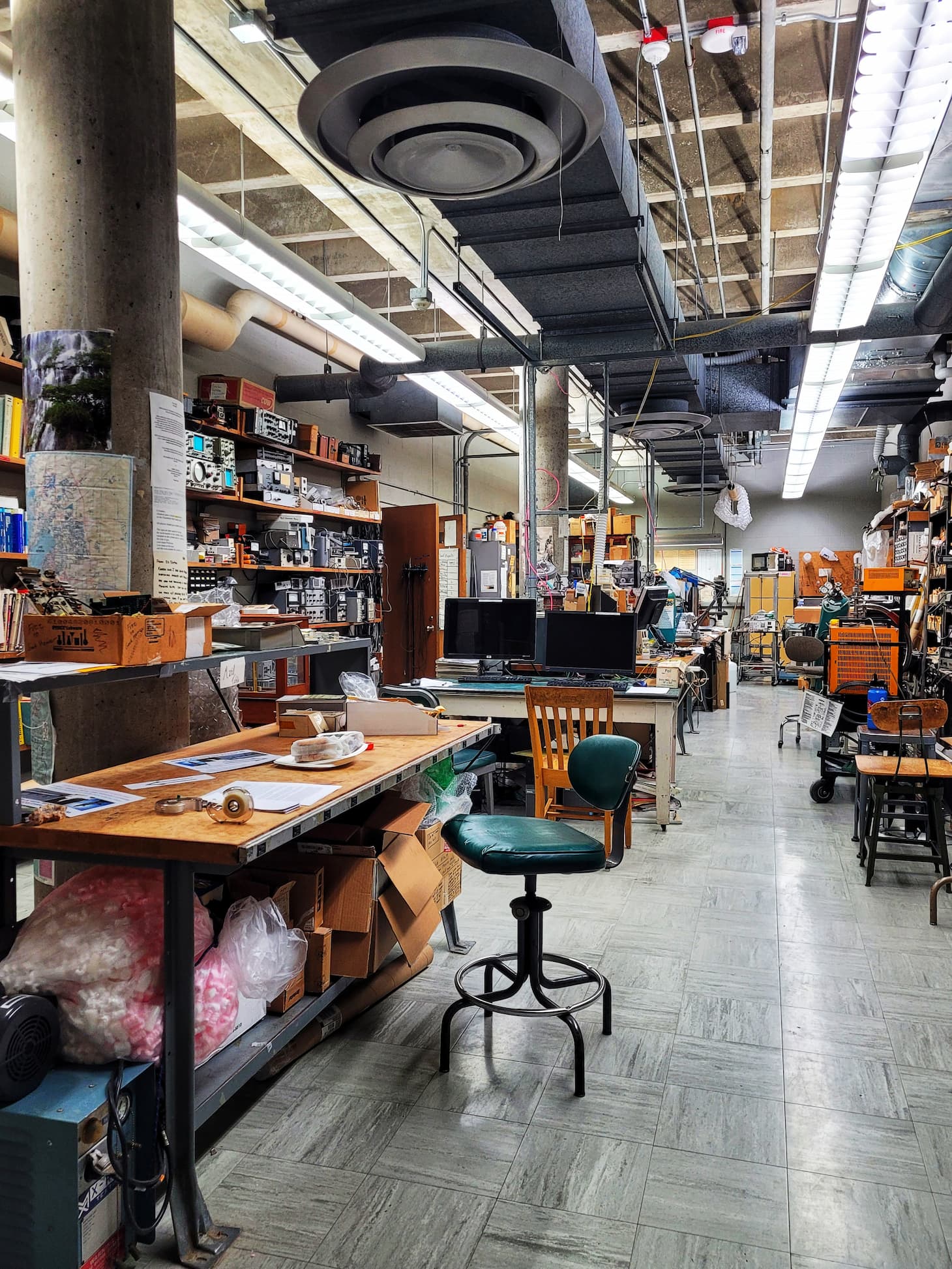
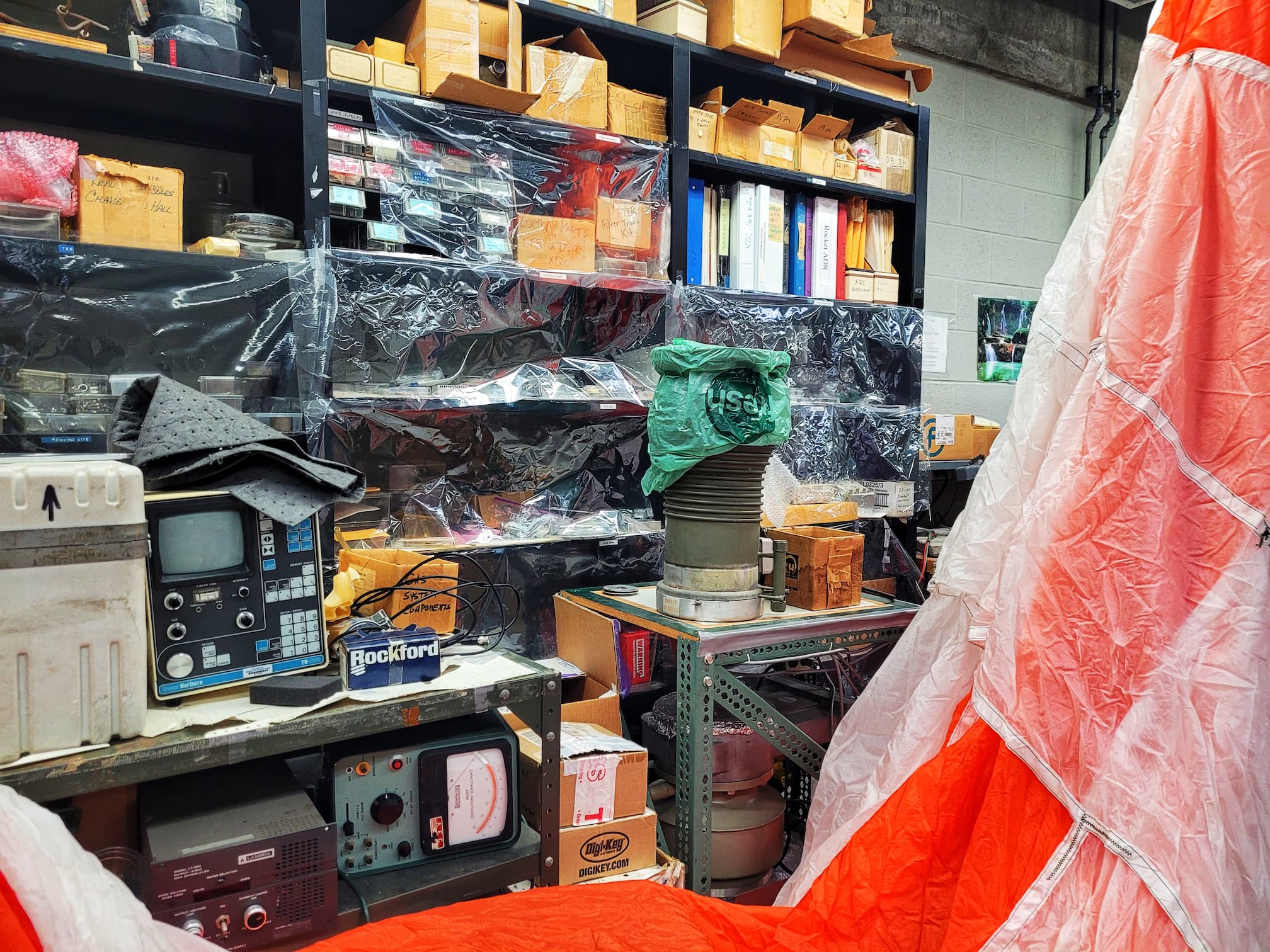
Next, we toured an X-ray astrophysics lab where researchers design and build rocket-based detectors to measure X-ray emissions in space. Roughly half of the “normal” matter in the universe is thought to exist as extremely hot, diffuse gas, which is invisible in optical light but detectable in X-rays.
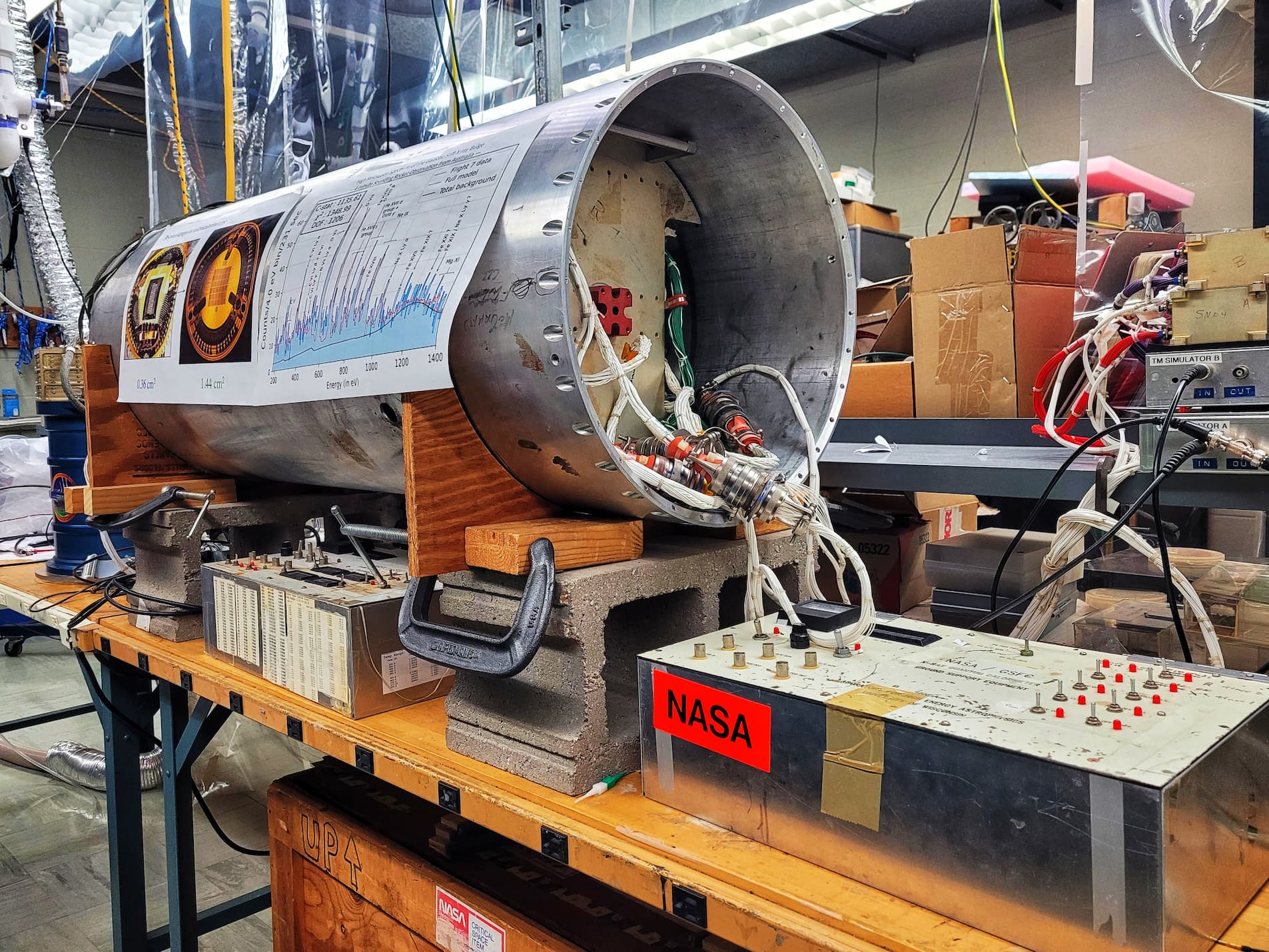
Part of our tour included seeing a rocket that has traveled to space seven times. The professor even invited us to touch it, “in case you haven’t touched something that’s been to space before.”
Vocab of the Day:
Diffuse gas: Low-density gas that is spread out rather than concentrated in compact clouds. It is typically characterized by high temperatures, low density, and no sharply defined boundaries.
The Radio Universe & Observational Cosmology
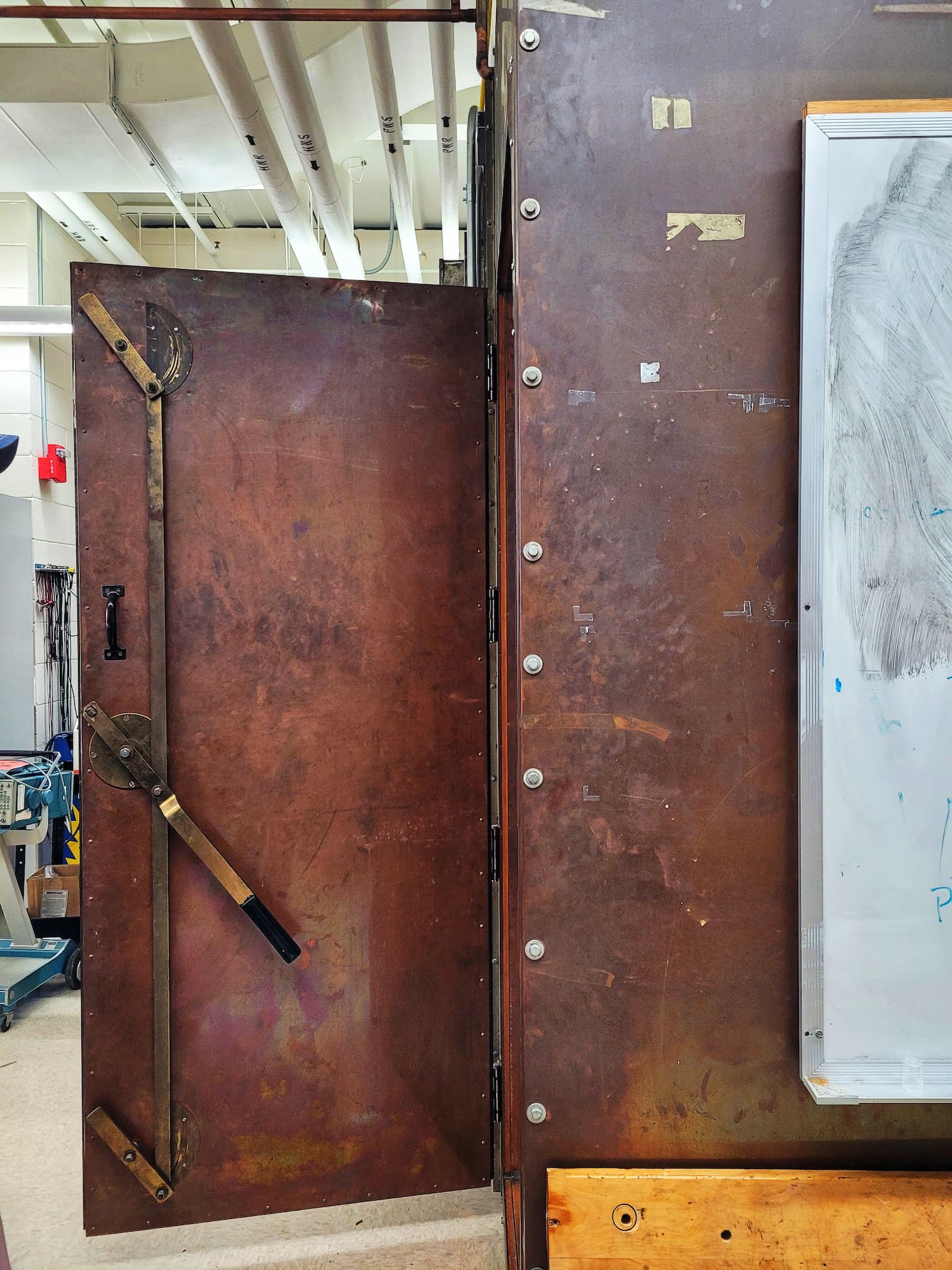
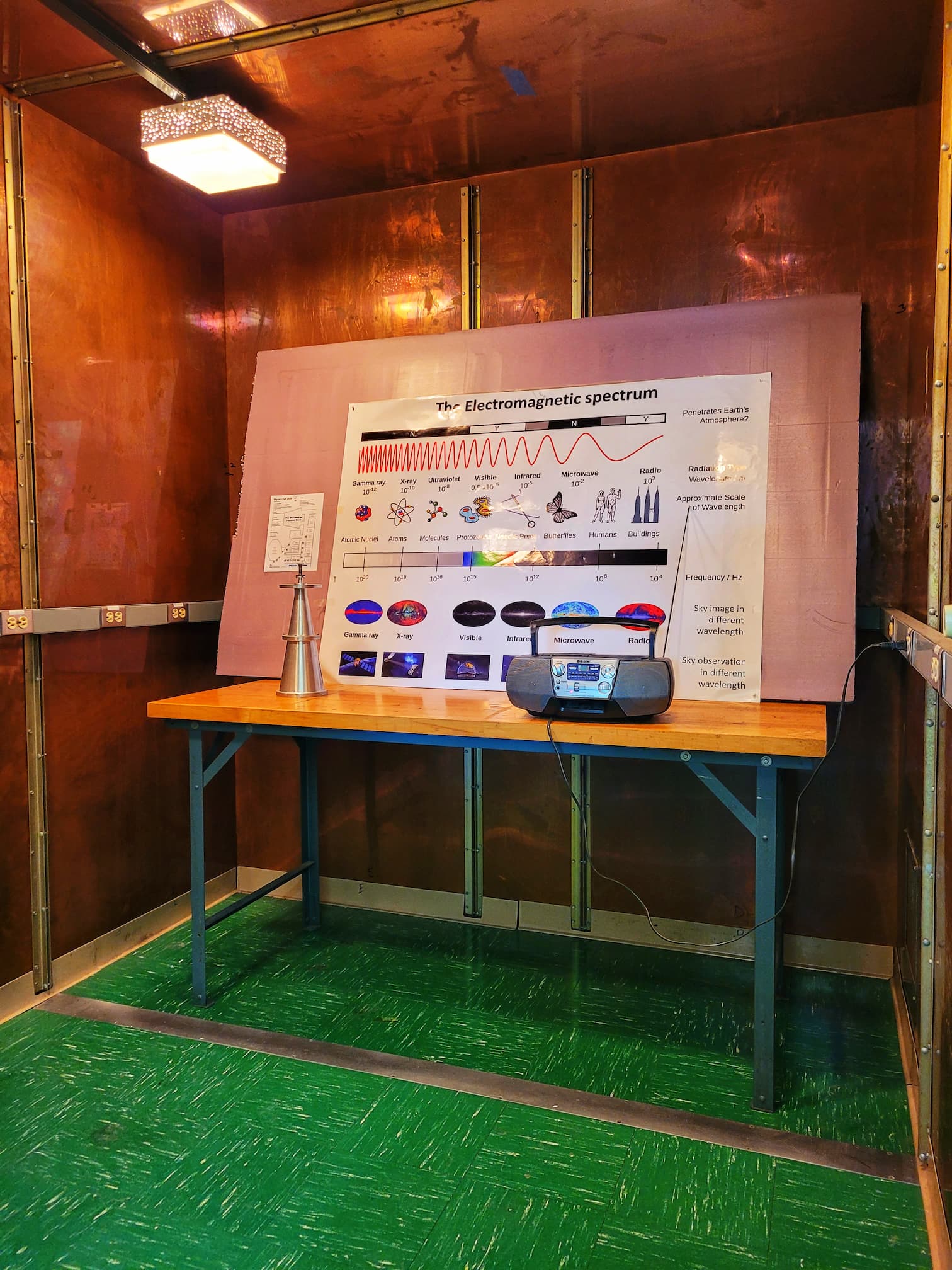
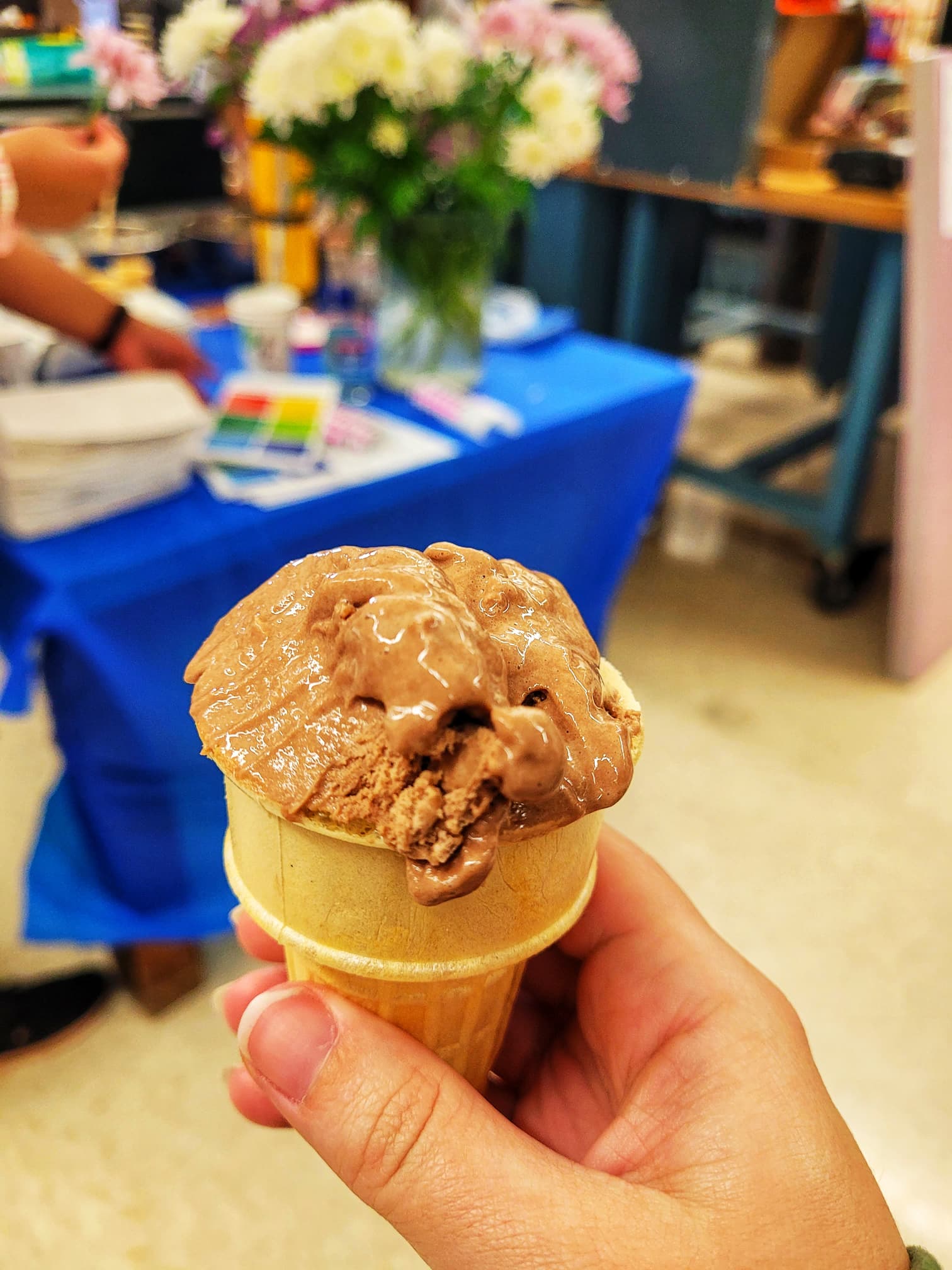
In one of the observational cosmology labs, we stepped inside a large Faraday cage, essentially an enclosure designed to block external electric fields. Seeing it up close made the concept far easier to understand than any diagram could. And in a fun contrast between serious research and playful science outreach, the team was also making ice cream using liquid nitrogen, which drew just as much excitement as the equipment.
Vocab of the Day
Faraday cage: An enclosure made of conductive material that shields its interior from static and non-static electric fields.
Madison Symmetric Torus
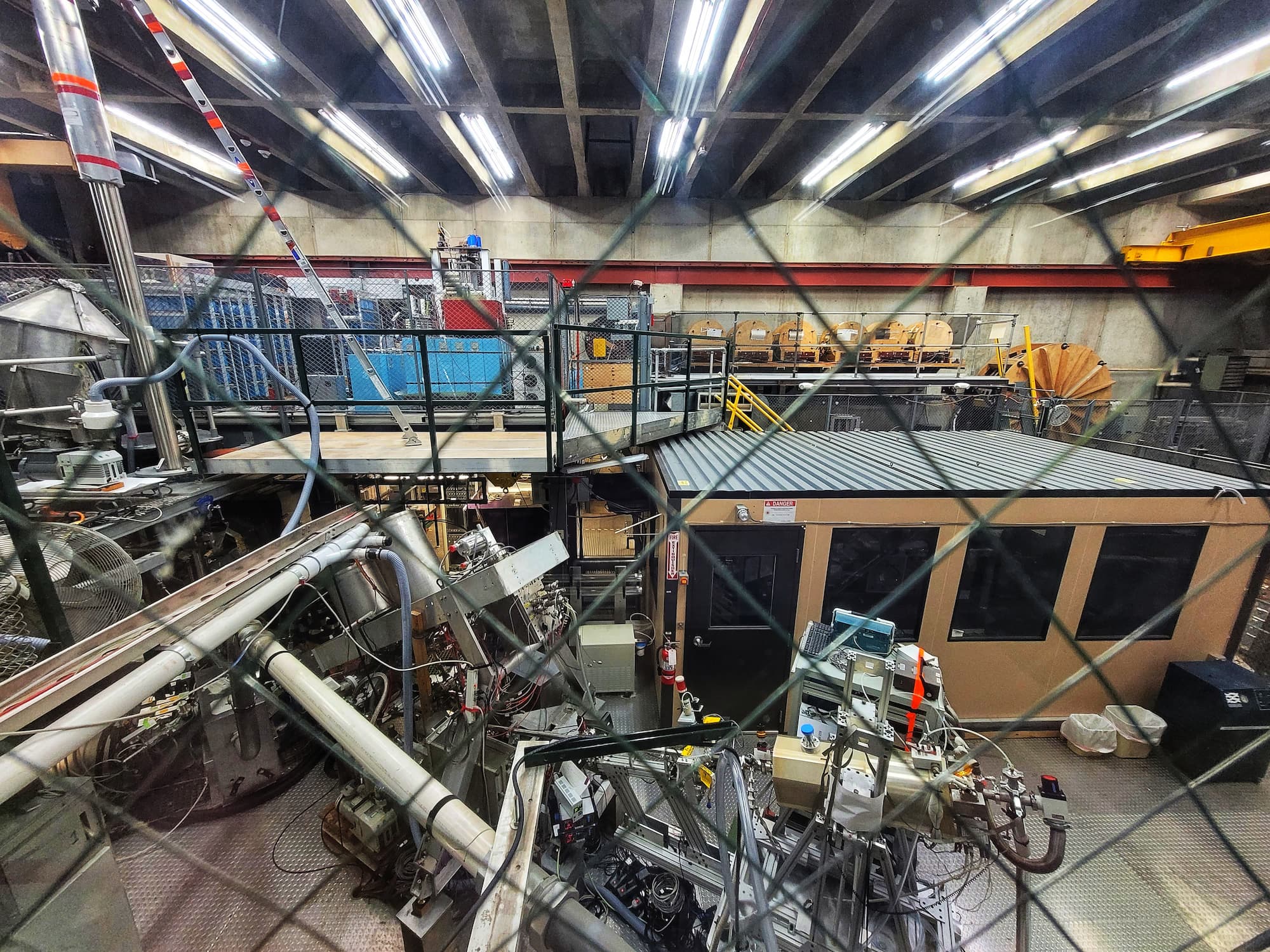
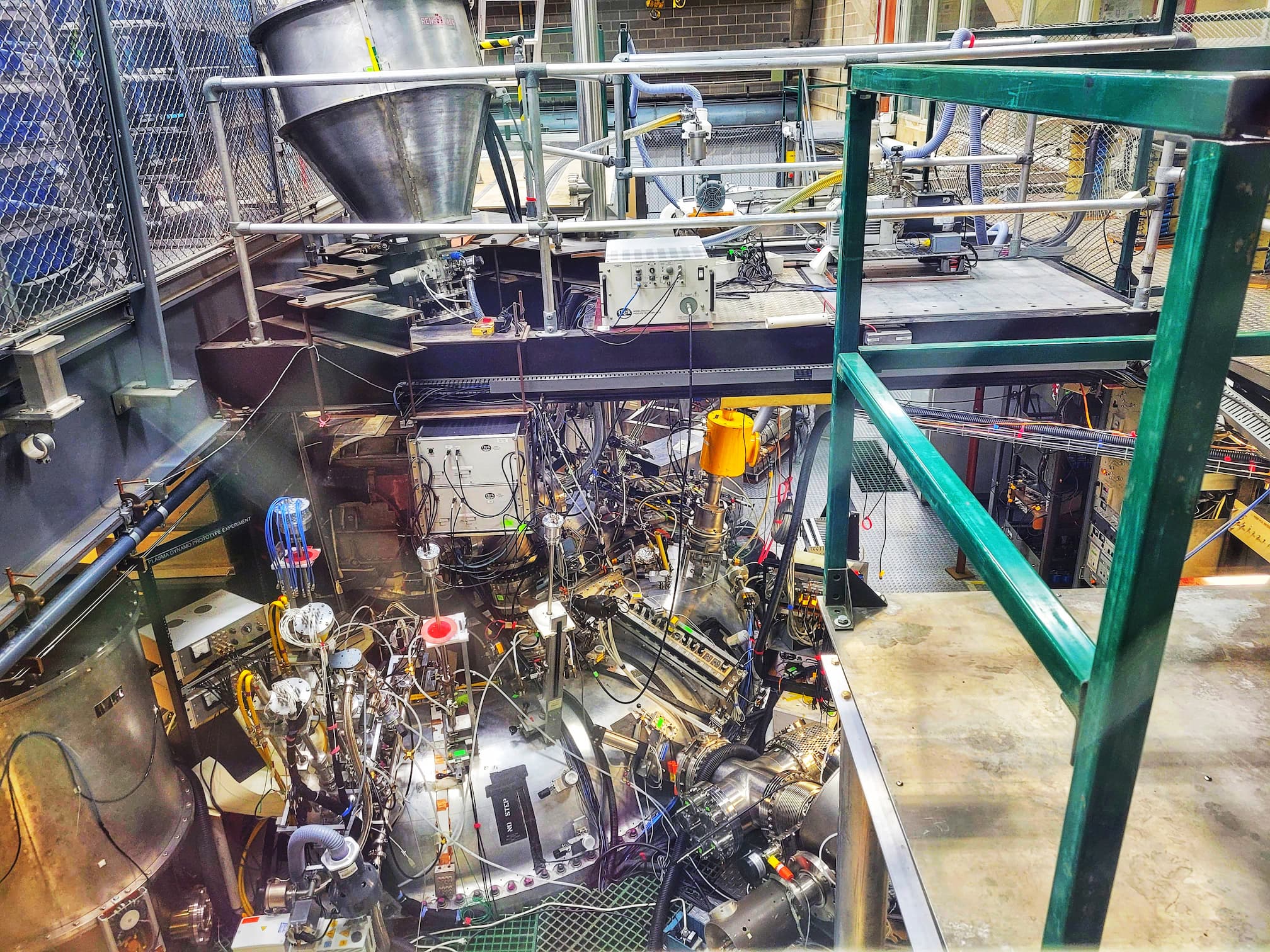
While walking through the hallway, we found the large glass windows overlooking a massive experimental device: the Madison Symmetric Torus. Our timing was perfect; as we were peering in, a tour group arrived, and we were able to join them.
The Madison Symmetric Torus (often called MST) is an experiment focused on plasma physics, with applications in fusion energy research and astrophysical plasmas. It produces toroidal plasmas, plasma confined in a donut-shaped configuration. Standing there, looking at a machine designed to study the same physical processes that power stars, it was hard not to feel a little awe.
Vocab of the Day
Plasma: The fourth state of matter, consisting of highly ionized gas with free electrons and positive ions.
Torus: A geometric shape formed by rotating a closed curve around an axis in the same plane without intersecting it, think donut-shaped.
Fusion energy: The process in which two light atomic nuclei combine to form a heavier nucleus, releasing enormous amounts of energy. (Most nuclear power plants today use fission, splitting atoms, rather than fusion, which combines them.)
Bonus Stop: Newton’s Apple Tree
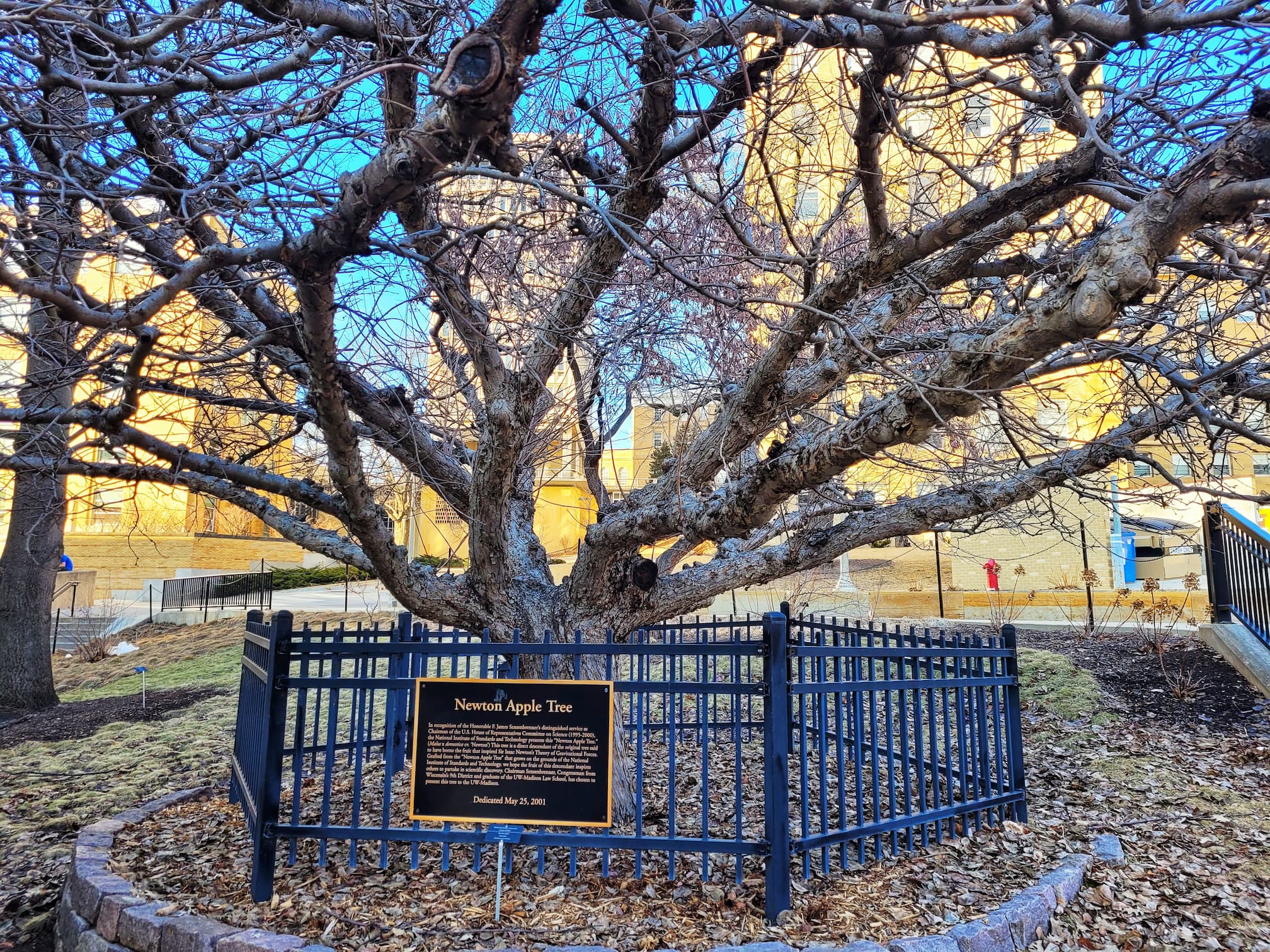
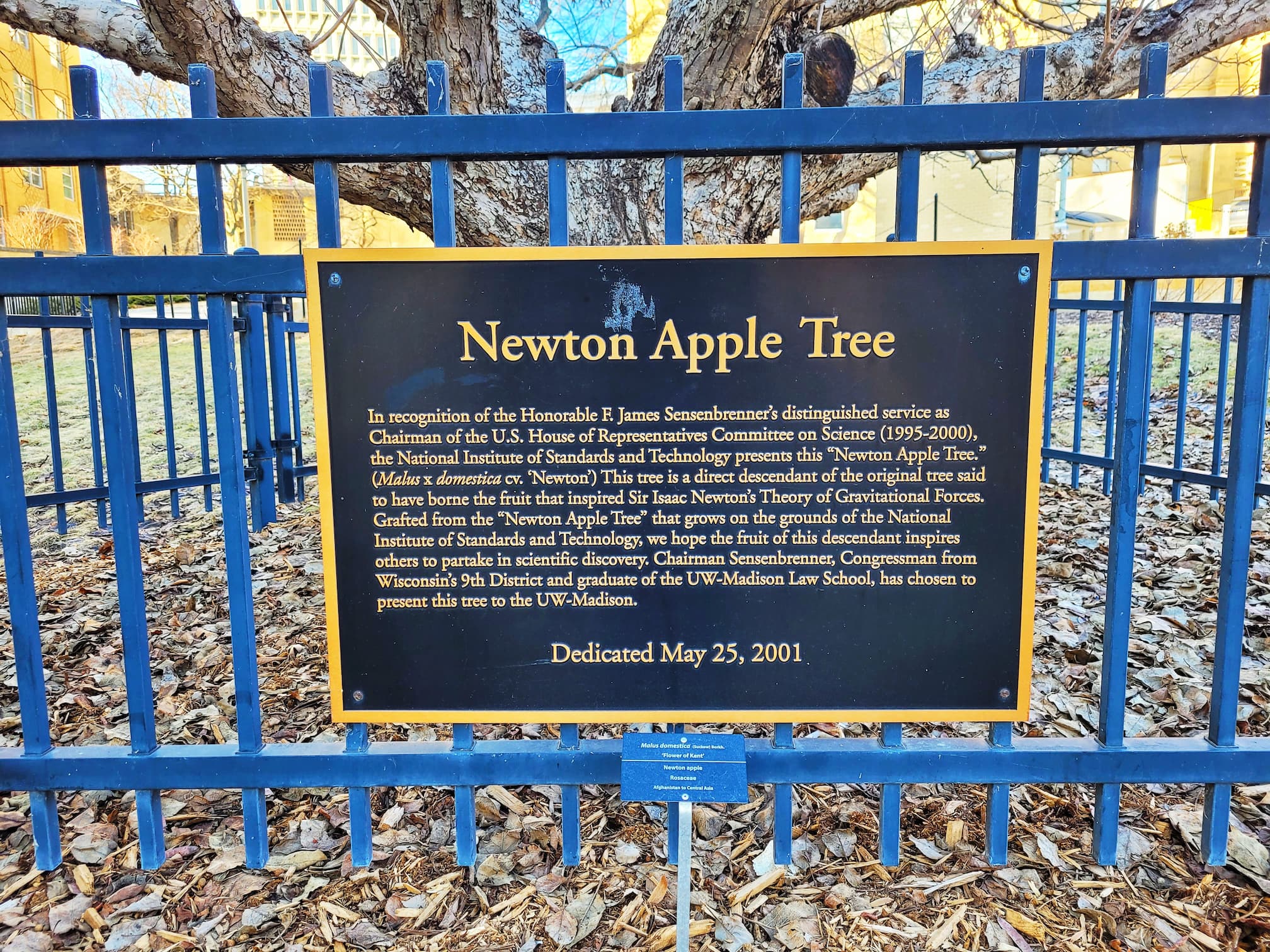
After finishing up inside Chamberlin Hall, we made one final stop just outside the building. Next door is the University of Wisconsin Botany Garden, home to a small but surprisingly significant apple tree. This isn’t just any apple tree, it was grafted from the original tree long associated with Isaac Newton and the famous falling-apple story. The original tree still stands at Woolsthorpe Manor, Newton’s birthplace and family estate in England, and was identified as the “inspiration tree” as early as 1806, largely because it was the only apple tree recorded in the garden at the time.
The University of Wisconsin’s descendant tree was donated by U.S. Representative F. James Sensenbrenner, who received it from the National Institute of Standards and Technology in recognition of his service as chair of the House Committee on Science. It was planted in the Botany Garden in 2001, where it continues to grow just steps away from the physics labs. There’s something poetic about that- a living branch of scientific lore planted beside a building where students are still asking big questions about how the universe works.